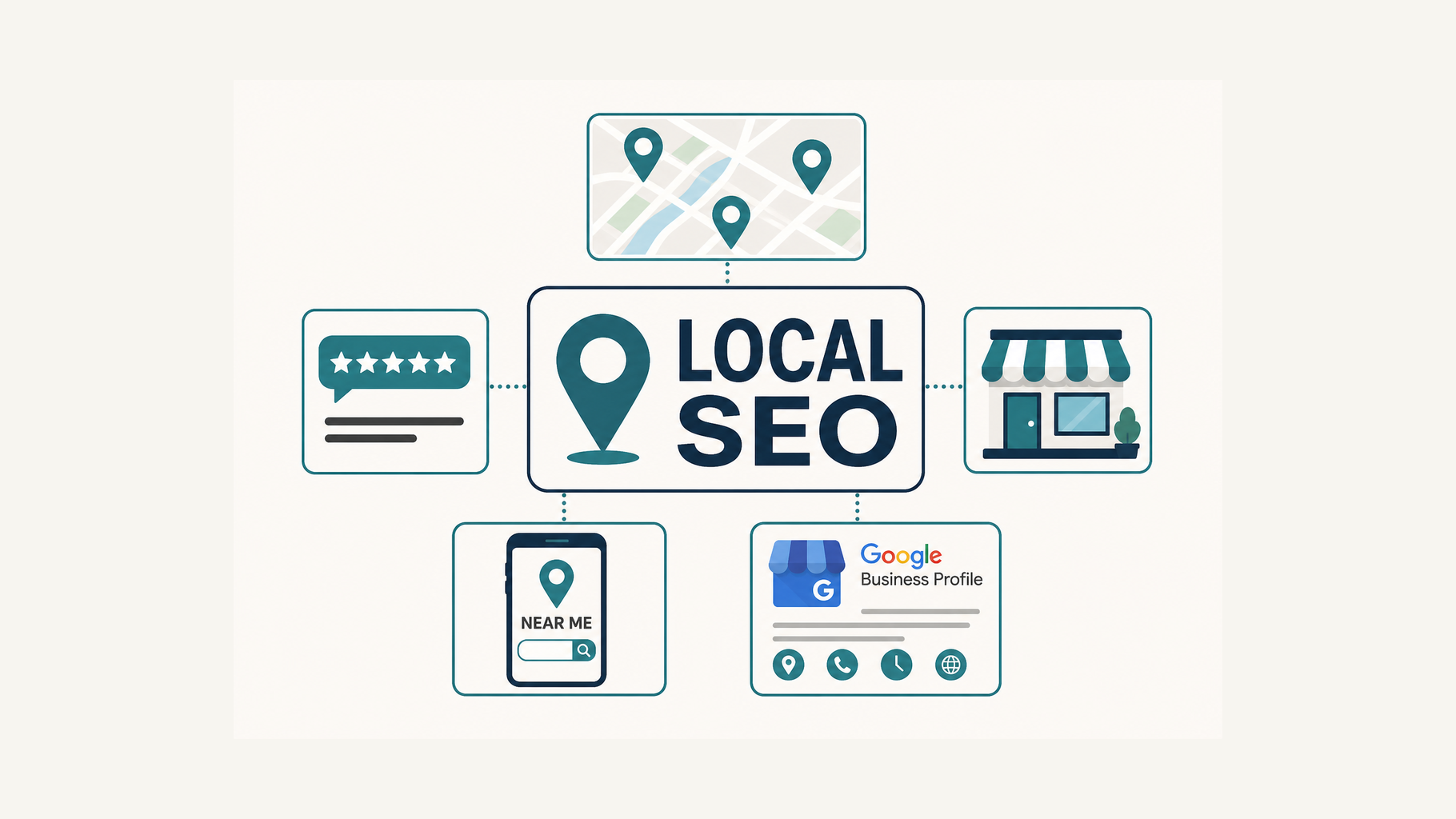
This is Part 7 of the Digital Yeast SEO course. So far we've covered ranking on terms people search across the country — keywords, content, on-page and technical. But if you run a salon, clinic, school, restaurant, hotel, or any business with a shopfront or a service area, the most valuable search isn't "best salon in Nigeria." It's "salon near me," "dentist in Ikeja," "event planner in Port Harcourt." That's the domain of local SEO.
What local SEO is
Local SEO is making your business appear when someone searches with a location — Google's map pack (the map with three business listings at the top of the results) and the organic "near me" results. It's the single highest-converting form of search for a business with a physical presence, because the searcher is already near you and ready to buy or book.
For Nigerian businesses — where a huge share of buying happens through local discovery, reviews and word of mouth — local SEO can outperform every other channel. Part 10 ties it into a full plan; this post is the local playbook.
The foundation: Google Business Profile
Your Google Business Profile (formerly Google My Business) is the centrepiece. Nearly every local result on Google draws from its data. To set it up properly:
- Create and verify the profile for your exact business.
- Fill every field: precise category, description, services, attributes, website, phone, WhatsApp.
- Use accurate, consistent NAP — Name, Address, Phone — matching exactly what's on your website and elsewhere.
- Add real photos of your premises, work and team.
Incomplete or inconsistent profiles are the #1 reason businesses underperform locally.
NAP consistency: your local trust signal
NAP stands for Name, Address, Phone — and consistency matters more than most people realise. Google cross-references your business name, address and phone across the web (your site, your profile, directories, social media). Every mismatch — "Digital Yeast" vs "Digital Yeast Ltd," a slightly different road name, a phone format change — weakens the signal.
The rule: write your NAP identically everywhere, forever. If your phone or address changes, update every single listing at once. We've seen businesses lose their map ranking purely from inconsistent data.
Citations and local listings
A citation is any mention of your NAP on another site — a business directory, a local association, a review platform. Consistent citations across trusted directories are a core local ranking factor, and they're the local sibling of link building (Part 8).
Start with the big ones that matter in Nigeria: Google Business Profile, Bing Places, Apple Business Connect, and credible Nigerian business directories relevant to your sector. Don't spam every directory — prioritise quality and consistency over quantity.
Reviews: the conversion machine
Reviews serve two jobs: they help you rank in the local pack, and they convert searchers who are comparing you to competitors. Most searchers make a buy/visit decision on a handful of reviews.
Practical review strategy:
- Ask satisfied customers for a review at the moment of maximum goodwill — right after the service.
- Reply to every review, good or bad, promptly.
- Make it easy: a short Google Review link on WhatsApp is the simplest ask in Nigeria.
Local content and landing pages
Beyond the profile, your website needs local signals too. Build a dedicated location page or locally-framed service page for each area you serve: "Web design in Abuja," "Web design in Lagos," "Event planning in Port Harcourt." Each page should be genuinely useful (not duplicated), include local specifics, and link naturally. This is where keyword research for local terms pays off.
Embed your map and your consistent NAP on the page, and add local business schema so search engines unambiguously understand your name, address and phone.
Your local SEO checklist
- Google Business Profile created, verified and completed — with photos.
- NAP identical on your site, profile and every listing.
- Consistent citations on 3–6 credible directories.
- A review process that generates steady, genuine reviews you reply to.
- Local pages for each service area, with map + schema.
Where this fits the course
Local SEO sits right after GEO (Part 6) and before link building (Part 8), and it overlaps with both — AI engines also cite local data, and local mentions build authority. Next up: how to earn links and off-page authority. Browse the whole course any time.
This is Part 7 of the Digital Yeast modular SEO course. Parts: 3: On-Page & Technical SEO, 4: Keyword Research, 8: Link Building. Start at Part 1 if you're new.

Comments (0)
No comments yet. Be the first to share your thoughts!
Leave a Comment
Your email address will not be published. Required fields are marked *