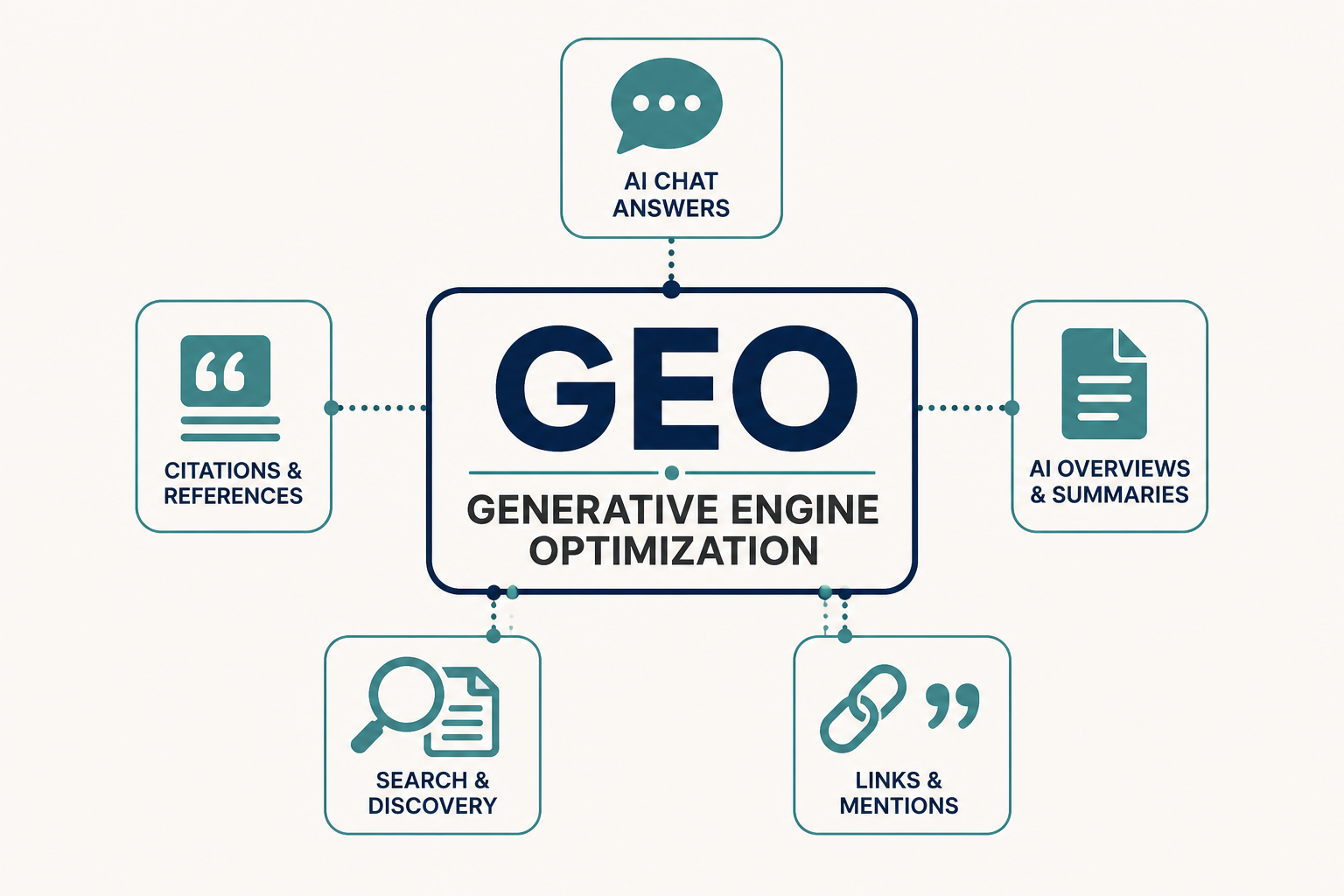
This is Part 6 of the Digital Yeast SEO course. In Part 5 we covered writing content that ranks. But ranking on Google is only half the battle in 2026 — a growing share of answers come from AI engines that don't show a list of ten blue links at all. They summarise an answer, and if your site is lucky, they cite you as the source. Getting cited is a different skill. This is that skill.
What GEO actually is
Generative Engine Optimization (GEO) is the practice of making your content the source an AI engine chooses to cite when it generates an answer. Traditional SEO gets you a position on a results page. GEO gets you a mention inside a machine-written answer — with your link attached.
The engines this applies to are the ones people actually use: ChatGPT, Google Gemini and AI Overviews, Perplexity, Microsoft Copilot, Claude, DeepSeek, Grok and Meta AI. Each has quirks — Perplexity cites sources far more prominently than Claude, while Grok values live, real-time data. But the foundation is the same: be clear, be authoritative, and be easy for a machine to quote.
If you've read Part 2, you already know the stakes — the zero-click surge, the CTR collapse on AI Overview queries, and the shift from "rank number one" to "be the source." GEO is the practical response to that.
The three levers that actually move the needle
Let's start with the honest version. People love to chase shiny new files and tactics, but the real 2026 research keeps pointing to three boring, reliable levers:
1. Be quotation-worthy. AI engines favour content with high "fact density" — clear, specific, verifiable statements they can lift and attribute. A fluffy paragraph that makes no concrete claim is almost impossible to cite. Write answers up front, in the first 1–2 sentences of a section, and back them with specifics.
2. Be structurally legible. Clean H2/H3 headings, short direct answers near the top, bullet lists for enumerable facts, and logical page order all help a model extract your point. This overlaps with the on-page fundamentals in Part 3, but for AI extraction the payoff is more direct.
3. Be a recognised authority. Engines cite trustworthy brands and well-established sources more than unknowns. Genuine mentions, links, reviews, and consistent NAP/entity data all feed this — which is exactly what link building (Part 8) and local SEO (Part 7) build on.
What about llms.txt? (Do we all need it?)
Short answer: no — not as a priority, and not yet. llms.txt — a community-proposed Markdown file at /llms.txt that hand-picks your most important pages for AI crawlers — took off as a trend in 2025, with headlines claiming every site needed one. The actual data tells a cooler story:
- Roughly 9–10% of domains have published one, with no correlation to better citation rates.
- One 2026 study of 94,614 AI-cited URLs found an
llms.txtfile on 1 of them. - No major AI vendor (OpenAI, Google, Anthropic, Perplexity, Meta) has officially confirmed honouring the spec, and Google's John Mueller has said Google does not use it as a ranking factor.
So treat llms.txt as low-cost optional — a small upside, minimal downside, but not a lever to build a strategy around. The machine-readable controls that do matter are your existing robots.txt entries for the AI user agents (GPTBot, ClaudeBot, PerplexityBot, etc.) and proper structured data — those tell crawlers what to read, which is the part that actually works.
A GEO quick-start checklist for your business
- Write a direct answer at the top of every important page (1–3 sentences, no hedging).
- Structure each section around one clear claim with supporting specifics.
- Keep factual density high — specific numbers, prices, dates, locations where relevant.
- Keep your site welcoming to AI crawlers (
robots.txtuser agents) rather than blocking them. - Build genuine authority — mentions, links, consistent entity data — so the engines want to cite you.
- Add proper schema markup so entities and Q&A are unambiguous.
- If you want, add
/llms.txtas a convenience — but don't expect it to move citations on its own.
Where it ranks in the course
GEO sits right after content (Part 5) and before local (Part 7), because it's an extension of content strategy: how the content you write gets picked up by AI engines. Next we'll cover local SEO — how businesses with a physical presence win the "near me" searches that AI hasn't replaced. Or browse the whole course.
This is Part 6 of the Digital Yeast modular SEO course. Read Part 1: What is SEO, Part 2: How has AI changed SEO, Part 3: On-Page and Technical SEO, Part 4: Keyword Research and Part 5: Content SEO for the foundations.



Comments (0)
No comments yet. Be the first to share your thoughts!
Leave a Comment
Your email address will not be published. Required fields are marked *