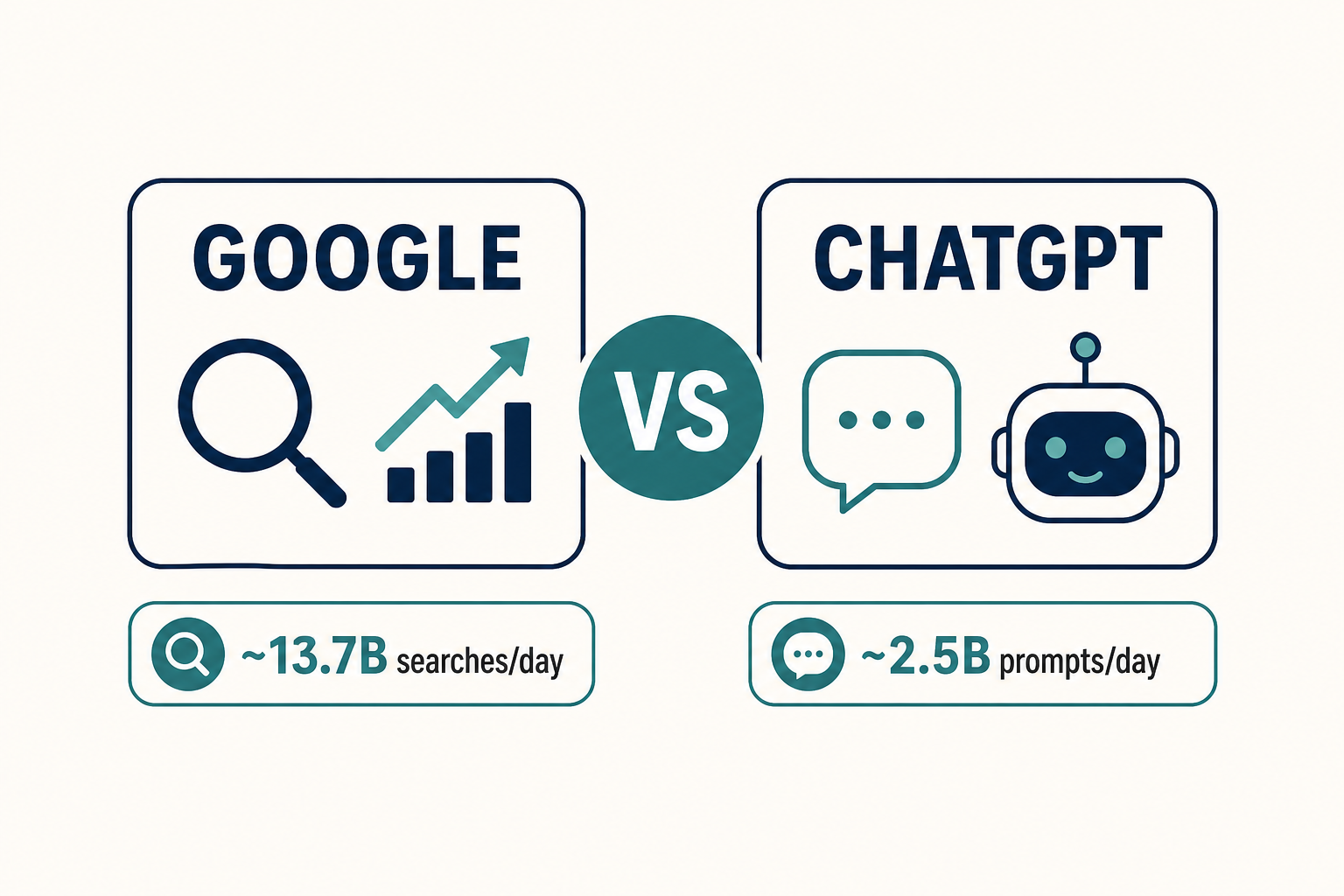
For two decades, "SEO" meant one thing: rank on Google. In Part 2 of our course we looked at how AI Overviews rewired the results page. This post looks at the bigger story — ChatGPT vs Google head to head, with real figures — because if you run a website, this is the number that should shape 2026.
ChatGPT is now a bigger "search engine" than Bing
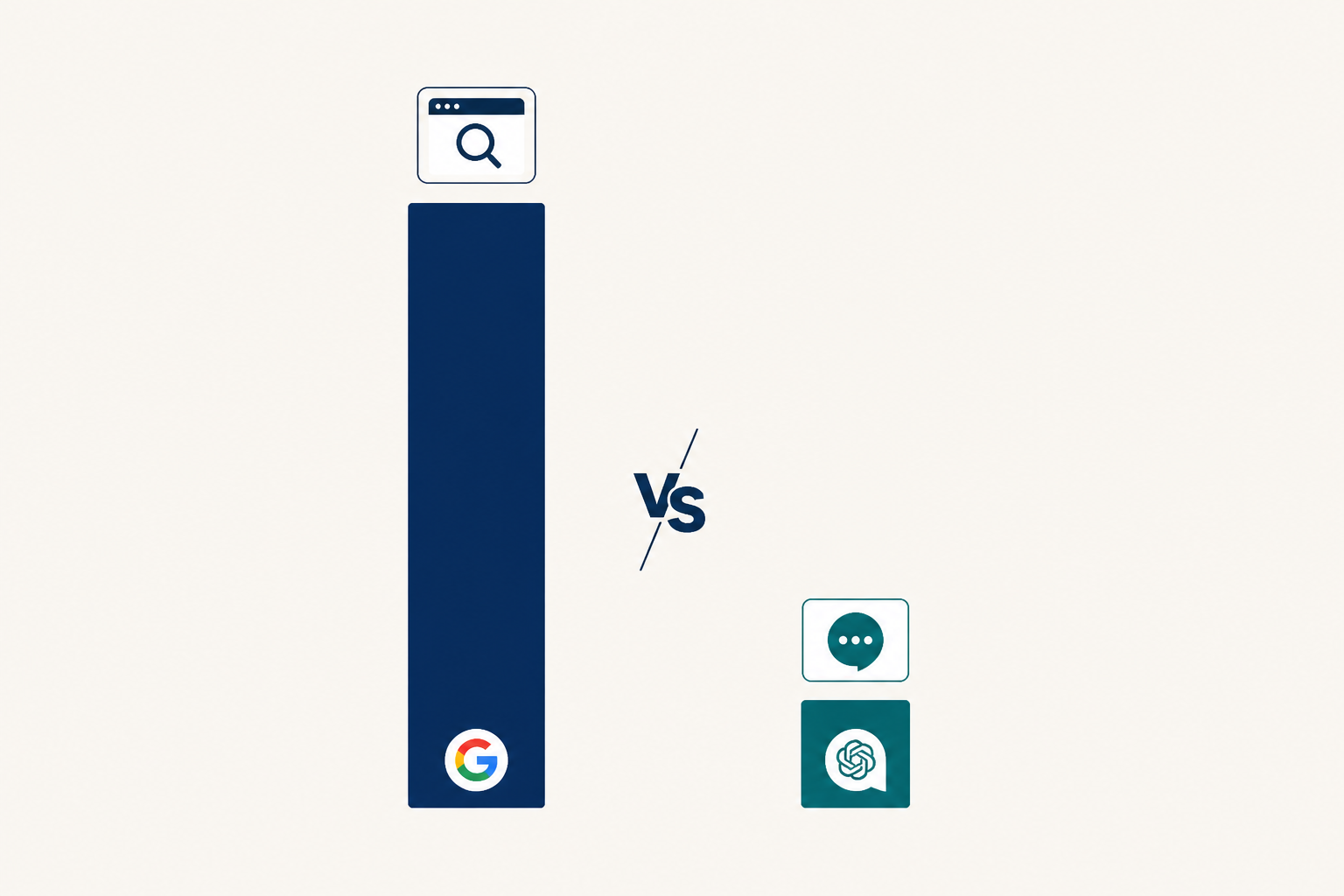
The most striking stat is about pure volume. Google processes roughly 13.7 billion searches a day (5 trillion+ a year). ChatGPT handles around 2.5 billion prompts a day — and when you filter out chat and ask only about search-like queries, that's roughly 1.6 billion a day, or about 12% of Google's volume.
To put that in context: Bing processes around 1.2 billion searches a day. ChatGPT has overtaken Bing and is now the second-largest search platform on the planet — in less than three years since launch.
Users: the growth is staggering
OpenAI reported around 400 million weekly active users in March 2025, more than doubling to roughly 900 million by 2026. Some 2026 estimates put unique users near 800 million. Either way, ChatGPT now reaches an audience Google-sized — and it's growing faster than any search tool ever has.
The paradox: ChatGPT sends almost no traffic
Here's the number that should worry every publisher. An Ahrefs analysis of ~76,000 websites found:
- Google delivers ~40% of total website traffic — the single biggest referral source on the web.
- ChatGPT delivers ~0.2% — despite the billion-plus daily queries.
That's a 190:1 traffic gap. Google's whole business is sending people to click links. ChatGPT's business is answering you inside the chat window, and it links out to sources only when it grounds an answer in real-time search. This is the structural reason SEO is changing.
What this means for your business
These figures don't mean "Google is dead." Google still sends ~200x more traffic. But they mean two things:
- Google is still where clicks come from — so classic rankings still matter, more than ever.
- AI citation is the new frontier — since ChatGPT resolves so few queries by sending people to websites, the prize is now being the site it cites. That's Generative Engine Optimization, and it's covered in Part 6 of our course.
The goal in 2026 isn't rank-only. It's being visible and citable wherever people search — Google and ChatGPT and Perplexity and the rest.
Sources
- ALM Corp breakdown of ChatGPT vs Google volume and the 190x traffic gap
- Business of Apps — ChatGPT statistics (users, revenue)
- Techwey — ChatGPT Search vs Google performance analysis
- Omnibound — ChatGPT user statistics
This is a standalone look at the numbers. For the practical playbook, see Part 3: On-Page and Technical SEO and Part 6: GEO in our SEO course.
Comments (0)
No comments yet. Be the first to share your thoughts!
Leave a Comment
Your email address will not be published. Required fields are marked *