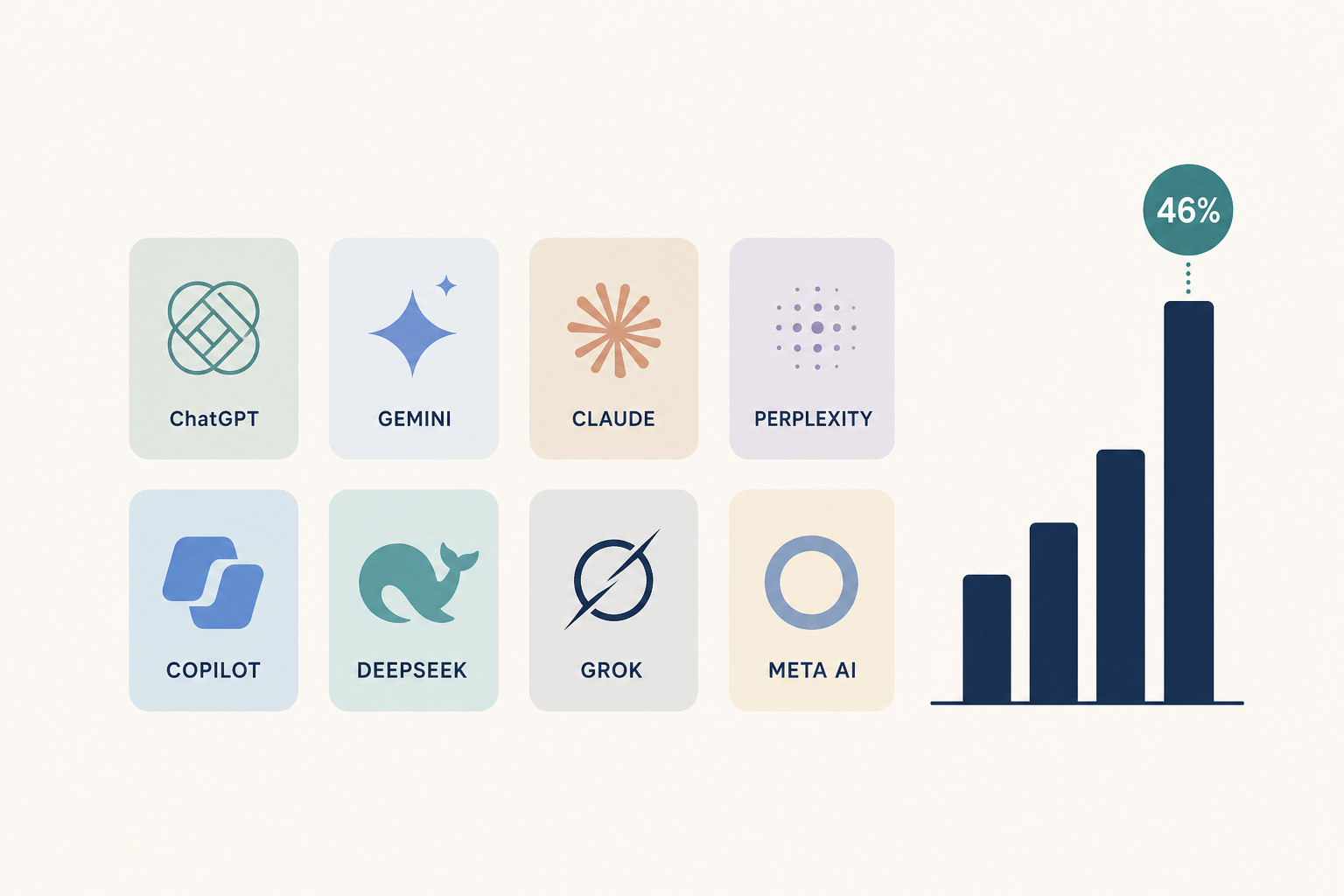
Remember when comparing search engines was simple? Google, Bing, Yahoo, DuckDuckGo — pick your champion, watch the same league table, argue about the same numbers. That era is gone. SEO's new question is which answer engine deserves your time, and the honest answer is: the league table barely exists yet.
At Digital Yeast, we build sites and then we get them found — in Google AND inside AI answers. So we spent the last few weeks pulling together every reliable, sourced market-share figure we could find for the major LLMs, separating the real numbers from the educated guesses, and being upfront about which is which.
Here's our 2026 AI SEO / AEO market share breakdown.
Why "AI market share" is harder to measure than "search engine market share"
Ten years ago, you opened StatCounter, saw Google at ~92%, Bing creeping toward 3%, and the picture was clear. There is no equivalent for AI engines. "Market share" across the LLMs gets measured three different ways, by three different firms, producing three different league tables:
- Web-traffic share — how much of all generative-AI website traffic each platform gets (Similarweb).
- App-user share — the share of global AI-assistant users (Sensor Tower's "True Audience" metric).
- Referral-click share — which platform actually sends traffic out to real websites (Conductor).
These three disagree, because they measure different things. Web traffic counts casual visitors; app users count registered actives; referrals count the clicks that matter to you. We'll use all three, clearly labelled, because each tells you something the others miss.
There's also a data-quality problem. ~70% of AI referral traffic is misclassified as "direct" in GA4 (The Digital Bloom), so even the "real" numbers undercount. Treat everything below as directional, not gospel.
The 2026 league table (the numbers we can actually source)
Here's the honest picture, combining the best-sourced figures across the three metrics:
| Engine | AI-chatbot web-visit share (Similarweb, Jun 26) |
Active users (MAU) | Trend |
|---|---|---|---|
| ChatGPT | 52.7% | 1.1B+ | Share falling (76%→53%), still #1 |
| Gemini | 27.8% | ~900–950M | Surging, now #2 |
| Claude | 9.2% | ~245M | Fastest-growing, highest value/user |
| DeepSeek | 3.6% | ~97M (Apr 25, stale) | Stable ~4%, cost-led |
| Grok | 2.5% | ~50–117M* | X-integrated, steady |
| Microsoft Copilot | 2.0% | ~33–100M* | Enterprise (web misses M365 usage) |
| Perplexity | 1.1% | ~45M | Small share, top link-citation rate |
| Meta AI | No separate website (in-app) | Huge, +973% YoY | Zero outbound web referrals |
* Low-confidence / conflicting MAU figures (Copilot, Grok) — see notes below. Sources: Similarweb worldwide AI-chatbot web-visit share, June 2026 (Similarweb, Deborah); MAU figures from Sensor Tower / company reporting via Digital Applied, TechCrunch and First Page Sage.
One measure, every row. Every share above is the same kind of number — Similarweb’s worldwide share of visits to the major standalone AI-chatbot websites, June 2026 — so the column reads cleanly and every engine is compared on equal terms. App-user and referral figures are discussed separately with their own sources below, because they measure different behaviour.
ChatGPT — still the giant, now shrinking in relative terms
ChatGPT is the fastest app in history to reach a billion monthly users, hitting that mark in May 2026 (Reuters via First Page Sage). Its weekly active users passed 900 million at the start of 2026 (First Page Sage). On absolute terms, nothing is close.
But the pie is growing faster than any single slice. ChatGPT's share of worldwide generative-AI web traffic fell from roughly 76% in June 2025 to about 53% by May 2026 (Similarweb), and its share of global AI-assistant users dipped below 50% for the first time, to 46.4% (Sensor Tower via Digital Applied). It didn't shrink — the competition grew.
The statistic that matters most for SEO: ChatGPT still sends the most referral clicks out to websites (~87% of all AI referral traffic per Conductor). Even as its share of conversations falls, it remains the #1 source of measurable AI traffic to your site.
Verdict: optimise for ChatGPT first. It reaches the widest audience AND the most qualified referral traffic.
Gemini (Google) — the distribution monster that just became #2
Gemini is the clearest challenger, and it's growing through distribution, not model-superiority. Google reports its app has passed ~900–950 million monthly users (The Verge); Sensor Tower's deduplicated count puts it at ~662M — a methodology gap, not a contradiction. However you count it, Gemini overtook Perplexity as #2 during 2026 and now holds ~27.7% of global assistant users (Sensor Tower via Digital Applied).
Its web-traffic share roughly quadrupled, from ~5.7% to 21–27% in a year (First Page Sage, Similarweb). Why? Android, Workspace and Search — Gemini is baked into Google's OS, so it collects usage no standalone assistant can match.
Compound that with Google's own AI answers: AI Overviews now appear on ~48% of US queries (up from ~31% in Feb 2025) per Ahrefs via Digital Applied. If you rank well on Google, you're already partly optimised for Gemini.
Verdict: optimise for Gemini second. Good, traditional on-page SEO is the entry ticket — see what is SEO if you need the foundation.
Claude (Anthropic) — small audience, highest value per user
Claude is the paradox of the 2026 race: the fastest-growing major platform by share (+452% YoY and roughly 4x its users in five months to ~245M MAU), yet it's the least-dominated by raw clicks (Sensor Tower via Digital Applied). Its worldwide web-traffic share rose from ~2% to ~9% in a year — the largest proportional gain Similarweb tracked (Similarweb), and its web traffic grew roughly 770% between 2024 and 2026 (Woyable).
The twist is monetisation. Claude earns $2.76 per US mobile user vs ChatGPT's $1.74, and 13% of its users pay — the highest conversion of any major assistant (Sensor Tower via Digital Applied). And it mentions brands in ~97% of responses, the highest rate of any platform (Spotlight).
Verdict: optimise for Claude if your product is high-ticket or B2B. A smaller, higher-intent, paying audience can beat a bigger casual one.
Perplexity — the citation engine worth more than its size
Perplexity is the most search-native of the LLMs — built to answer with cited sources. It holds roughly 6–8% of AI-chatbot share with ~45M users, but includes links in ~77% of responses, the highest of any major platform (Seoprofy via theStacc, Spotlight).
Its US AI-referral share fell from ~11.4% to ~6.9% in a year as Gemini surged (SE Ranking), yet for a content site, Perplexity punches far above its user count because it's the platform most likely to send readers to your page.
Verdict: optimise for Perplexity for citation-driven referral traffic — a great early win while Gemini and Claude scale.
Microsoft Copilot, Meta AI, DeepSeek and Grok — the small tail, read carefully
Below ~10% the picture gets thinner. Web-visit share is measured and real (see the table). What’s not reliably published is their outbound referral behaviour and MAU counts — the numbers that tell you whether each is worth chasing. Here’s what we actually know:
DeepSeek — holds a real, stable ~3.6–4% of worldwide AI-chatbot web visits (Similarweb), the cost-led open-weight option. It declined from its early-2026 spike but isn’t fading. Its published ~97M MAU (sqmagazine) dates to April 2025 and is stale. Its outbound referrals to Western sites appear small, given data-residency friction and modest Western consumer adoption — treat that referral figure as directional, not measured.
Grok (xAI) — ~2.5% of worldwide AI-chatbot web visits (Similarweb). Heavily tied to X, so its MAU is genuinely murky: conflicting public figures range 50M–117M (fatjoe), and web-share panels likely undercount an audience that lives inside X. Expect low but real referrals from an X-centric base.
Microsoft Copilot — ~2.0% of AI-chatbot web visits (Similarweb), but that understates reach because much Copilot usage happens inside Windows and Microsoft 365, never touching a chatbot website. Public consumer MAU claims span 33M–100M+ with conflicting methods (Seoprofy via theStacc). Its referrals are real but enterprise-weighted.
Meta AI — the structural outlier. It’s one of the fastest-growing platforms (+973% YoY MAU per First Page Sage) because it’s embedded free in WhatsApp, Instagram and Facebook. But it has no standalone website, answers in-place, and sends effectively zero outbound web referrals — which is why no web-traffic panel can rank it. For publishers it matters as an audience, not as a traffic source. Genuine measurement gap, by design.
Why these gaps are actually good news for you
The absence of a reliable LLM market-share league table is not a failure — it's an opportunity gap. It means the field is early, under-measured, and still winnable. The brands that get cited across engines now, while most of their competitors are still optimising for one, will own the category while the data catches up. We cover exactly how to do this in our upcoming guide on generative engine optimization, and compare the two big search systems in our ChatGPT vs Google search statistics breakdown.
Practical takeaway: which engines to optimise for first
Our recommendation, based on the data above:
- ChatGPT first — widest reach AND most referral-traffic-to-your-site. No debate.
- Perplexity second — easiest citations, highest click-through per response. Best early ROI for content sites.
- Gemini third — huge and growing via distribution; mostly earned through solid Google SEO.
- Claude fourth — highest value-per-user; prioritise for B2B and high-ticket offers.
- Copilot, Meta AI, DeepSeek, Grok — watch, but don't over-invest until the measurement matures and your niche shows signals.
And the single insight that overrides all of it: "citing presence" is the new currency. The old SEO battleground was your position on page one. The new one is whether an AI engine can name you as a source when it answers a question. That's why clear, structured, citable content — the kind we walk through in our what is SEO explainer and our how AI changed SEO deep-dive — is now the foundation of everything, whatever engine you're chasing.
But build it on solid fundamentals first. Browse the Digital Yeast blog for the framework.
Sources
- Similarweb — AI Search Stats 2026
- Sensor Tower via Digital Applied — AI Assistant Market Share 2026
- First Page Sage — Google vs ChatGPT Market Share 2026
- Conductor — AEO/GEO Benchmarks Report
- Reuters — ChatGPT hits 1B MAU
- The Verge — Gemini 950M monthly users
- theStacc — AI Search Market Share 2026
- SE Ranking — AI Traffic Research
- Woyable — Most Popular AI Tools 2026 (Claude ~770%)
- Spotlight — Brand Share of Voice in AI Chatbots
- fatjoe — Grok AI Stats
Comments (0)
No comments yet. Be the first to share your thoughts!
Leave a Comment
Your email address will not be published. Required fields are marked *