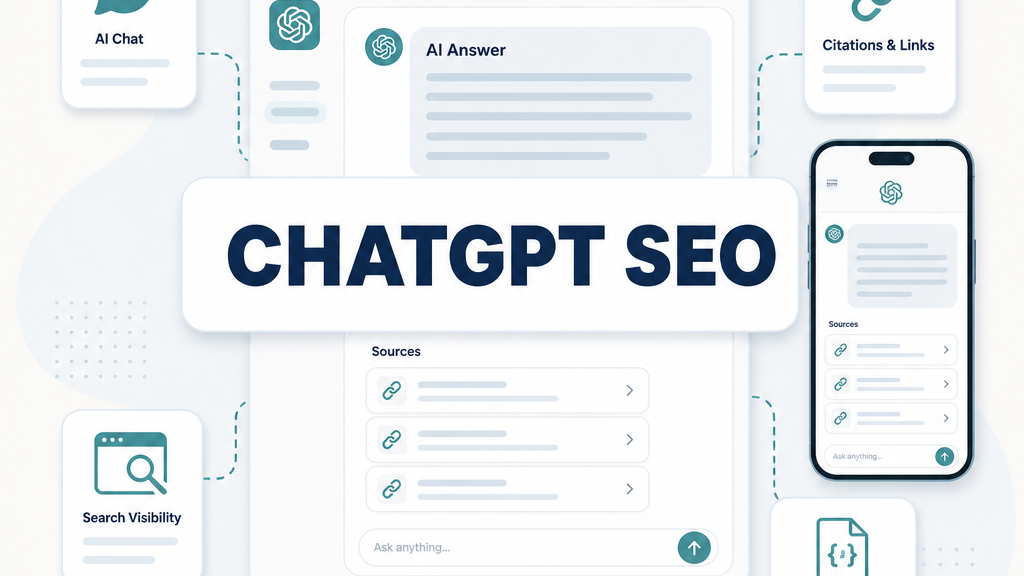
Every SEO instinct you have was built for a ten-blue-links world. Get to position one, win the click, done. But the person asking "which agency is best in Lagos" increasingly isn't opening Google — they're opening ChatGPT and getting a composed answer with a few links underneath. If your brand isn't in that answer, you don't exist.
This is the shift we covered in how AI has changed SEO with real numbers — and it deserves its own playbook. Because ChatGPT is not Google, and it's not Perplexity either. It has its own quirks, its own scale, and its own way of deciding who to cite. Here's how to win its attention, without gaming anything.
How Big Is ChatGPT, Really?
Start with the scale, because it drives everything else. OpenAI reports ChatGPT now has more than 900 million weekly active users and over 50 million consumer subscribers (OpenAI, "Scaling AI for everyone," Feb 2026). That's growth from roughly 800 million reported at Dev Day in October 2025 — essentially doubling in under a year.
For context, StatCounter puts ChatGPT at roughly 78% of AI chatbot market share, and Pew Research found 42% of US adults now use chatbots specifically to search for information. When the biggest assistant on the planet is a search destination, "ChatGPT SEO" stops being a novelty and becomes infrastructure.
How ChatGPT Answers (and When It Cites You)
Understanding the mechanics matters, because the citation behaviour is the whole game.
ChatGPT answers from two sources: its training data, and the live web. On its own, it composes answers from everything it has learned — and, as credible analysis of ChatGPT citations points out, it can sound confident and generate plausible-looking references even when nothing was retrieved. That's not a bug to exploit; it's why you can't fake your way into its answers.
When ChatGPT Search (the browser tool) is active, it actually queries the web before responding. Per OpenAI's own help documentation, "ChatGPT responses that use search will contain inline citations. You can hover over the citation to learn more and click on it to see the source." You'll see a Sources button on those responses.
That said, the picture is moving fast: a fresh investigation found ChatGPT increasingly draws on its own prepared index of the web — internally codenamed Labrador — alongside Bing-style retrieval, which is why we published a full breakdown of ChatGPT's own search index as a standalone report.
Here's the peculiarity that sets ChatGPT apart. Search is where its grounding and citations live — and it decides when to invoke it. A large share of the time, ChatGPT just answers conversationally from its training data, no links at all. That's the opposite of Perplexity, which is designed to cite a source on essentially every answer, and different again from Claude, which treats web grounding as an optional tool it reaches for selectively. So with ChatGPT, you're not optimising for one behaviour — you're optimising to be both the training-data answer and the cited source. Ranks matter less than presence.
The Practical Tactics That Get You Cited
So what actually increases your odds? It comes down to being an easy, trustworthy, obvious source for the questions ChatGPT actually gets asked.
Answer the question directly, right at the top. Put a clear, factual answer in the first paragraph or two. Whether ChatGPT is retrieving your page via GPT Search or recalling it, a buried answer is a skipped answer. Direct beats clever.
Write structured, extractable content. Use H2s that mirror real questions, short paragraphs, tables, lists, and clean definitions. Structured content is easier for language models to lift and cite than dense walls of prose.
Give ChatGPT a reason to trust you — the entity signals. E-E-A-T isn't just a Google buzzword here. Who you are, why you're credible, your experience, your establishment date, your location, your customer base — ChatGPT treats recognisable, verifiable brands as safer sources than anonymous pages. Make your authority explicit on-page.
Be a recognisable brand and domain. ChatGPT favours entities it has seen everywhere else. Being a real, mentioned, reviewed, cited brand — in directories, press, social, review sites — makes you a better citation candidate. Authority accumulated across SEO basics like quality backlinks transfers here too.
Be factually precise and consistent. One reliable, consistent answer across your site builds trust. Contradictory pages teach the model to prefer someone clearer. Never publish "staggering 98% improvement" claims you can't substantiate — factual precision is what gets you grounded over hype.
Add structured data (schema). Organisation, local business, article and FAQ schema help AI systems understand what your page is and who it's from. It's a grounding signal, not a guarantee, but it makes extraction dramatically easier.
Stay fresh. ChatGPT can score a retrieval against recency. Update data-heavy pages, add dates, and keep your most-citable facts current. Stale figures get replaced by fresher sources.
Write for the questions ChatGPT gets asked. People prompt with long, natural, conversational queries — "best affordable web design agency in Lagos for a small bakery." Content that cleanly matches those long-tail prompts is exactly what gets retrieved.
What Being Cited Is Actually Worth
Is it worth the effort? The data says yes — and it compounds.
Seer Interactive found that being cited in an AI answer is worth roughly +35% organic clicks and +91% paid clicks compared with not being cited. And unlike a position-one snippet that can vanish overnight, a citation is an endorsement the model keeps reproducing — the more you're cited, the more recognisable you become, the more you get cited. That flywheel is the whole long-term argument for generative engine optimisation as a discipline rather than a hack.
None of this replaces traditional SEO — it extends it. Getting cited alongside ranking is the goal, not instead of it. And if you want the data on just how radically this is reshaping search vs. Google, we've broken the trajectory down in ChatGPT vs Google: the search statistics.
The Honest Bottom Line
You can't hack a citation out of ChatGPT. What you can do is make your site the source a 900-million-user assistant naturally keeps choosing — direct answers, clean structure, visible authority, factual precision, and content written for the questions people actually ask in a chat box.
That's not SEO tricks. That's just being the best answer. And it's a strategy that works whether the machine quoting you is Google's search results, a ChatGPT answer, or a Perplexity page.
At Digital Yeast, we build fast, well-structured websites that make your authority impossible to miss — for Google and for AI equally. Want to be the cited source in your industry? Get a quote or browse more guides.
Sources
- OpenAI — Scaling AI for everyone (900M+ weekly users, 50M+ subscribers)
- TechCrunch — Sam Altman: ChatGPT hits 800M weekly users
- OpenAI Help Center — ChatGPT search: citations and sources
- Typescape — ChatGPT Citations Explained
- StatCounter — AI Chatbot Market Share
- Pew Research — Americans and AI 2026
- Seer Interactive — AIO impact on Google CTR
Comments (0)
No comments yet. Be the first to share your thoughts!
Leave a Comment
Your email address will not be published. Required fields are marked *