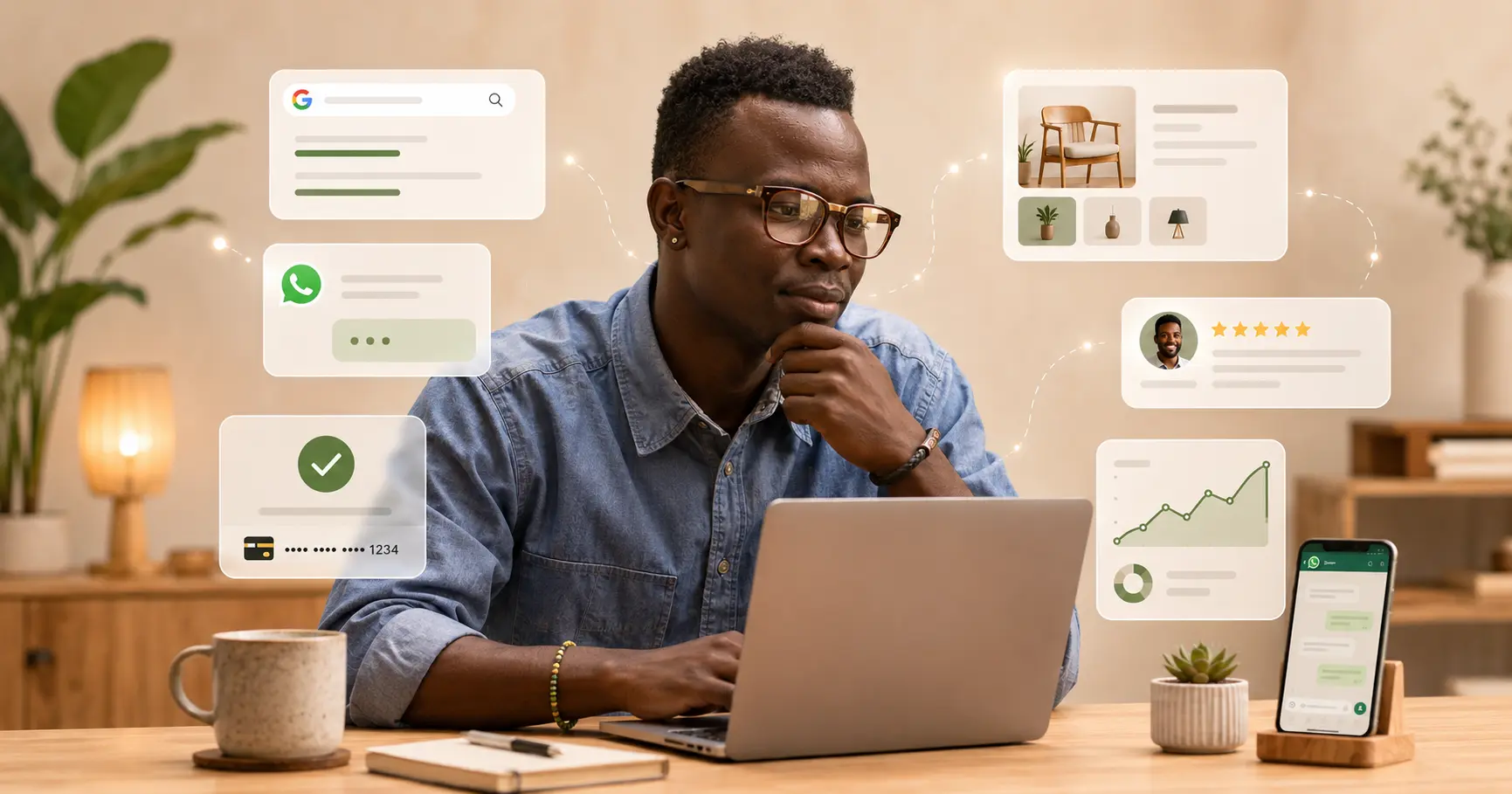
In Nigeria today, customers are no longer only walking down the street to compare shops. They are searching on Google, asking friends on WhatsApp, checking Instagram pages, watching TikTok videos, reading reviews, comparing prices, and looking for businesses they can trust before they spend money.
This is true whether you run a fashion brand in Lagos, a school in Abuja, a restaurant in Ibadan, a logistics company in Port Harcourt, a real estate agency in Lekki, a medical clinic in Enugu, a church, an NGO, a training centre, or a professional service firm.
The Nigerian customer has changed.
The question is no longer whether people use the internet. They do. Nigeria had about 109 million internet users at the end of 2025, according to DataReportal’s Digital 2026 Nigeria report. Broadband access is also improving, with NCC figures showing that broadband penetration crossed 50% in late 2025. The Nigerian e-commerce market is now estimated in billions of dollars, and mobile phones have become the main gateway through which many people discover, compare, and buy.
Yet many businesses still depend almost entirely on Instagram, Facebook, WhatsApp status, referrals, or a physical shop signboard.
Those channels are useful. In fact, your business should probably use them. But they are not a replacement for a proper website.
A website gives your business a permanent digital home. It gives customers somewhere to find you, understand you, trust you, contact you, buy from you, and recommend you. It also gives your business something social media cannot fully provide: ownership, structure, credibility, search visibility, automation, and long-term control.
In this article, we will look at the major benefits of having a business website in Nigeria, why a website is still important even if you already use social media, what your website should include, and how it can help your business grow.
What is a business website?
A business website is your official space on the internet.
It does not have to be complicated. It does not have to be a huge online store like Jumia or Amazon. A website can be as simple as a one-page business profile that explains what you do, shows your services, displays your contact details, and allows people to reach you on WhatsApp.
It can also be more advanced. Depending on your business, your website can include product catalogues, booking forms, online payments, a blog, customer testimonials, staff profiles, downloadable brochures, live chat, training registration, event pages, property listings, menus, appointment scheduling, or a full e-commerce store.
For example:
A school website can show admission information, fees, curriculum, photos, results, contact details, and application forms.
A restaurant website can show the menu, location, opening hours, delivery options, booking form, and WhatsApp order button.
A fashion brand website can show collections, sizes, prices, payment options, delivery information, and customer reviews.
A real estate company website can show available properties, photos, videos, neighbourhood details, price ranges, and inspection booking forms.
A church website can show service times, location, sermons, events, giving details, announcements, and livestream links.
A consulting firm website can show services, case studies, team profiles, client results, articles, and enquiry forms.
So when people say, “I need a website,” they do not always mean the same thing. The right website depends on the type of business, the stage of the business, the budget, and the goal.
But the main purpose remains the same: to help people understand your business and take action.
Do Nigerian businesses still need websites when they already have Instagram, Facebook and WhatsApp?
Yes.
This is one of the most important questions Nigerian business owners ask today.
Many businesses already get customers from Instagram, TikTok, Facebook Marketplace, WhatsApp groups, referrals, or status updates. Some business owners then assume that a website is unnecessary.
But social media and websites do different jobs.
Social media is excellent for visibility. It helps people discover your business, see your updates, react to your content, and start conversations. WhatsApp is excellent for quick communication. It allows you to answer questions, send prices, confirm orders, and follow up with customers.
But your website is your central business asset.
Social media is rented land. Your account can be hacked. Your page can be restricted. Your reach can drop. The algorithm can change. Your old posts can disappear under new content. A customer who saw your product last month may struggle to find the exact post again. And when everything is hidden inside chats, captions, highlights, and status updates, customers may not get a clear picture of your business.
Your website solves that problem.
It gives you a stable place to organise your information properly. You can have pages for your services, products, pricing, frequently asked questions, testimonials, contact details, and blog posts. You can send customers to one link and let them understand your business without repeating the same explanation every day.
The best strategy is not website versus social media.
The best strategy is website plus social media plus WhatsApp.
Use social media to attract attention. Use WhatsApp to communicate. Use your website to build trust, organise information, capture leads, rank on Google, and convert interest into action.
1. A website makes your business look more credible
Trust is one of the biggest issues in Nigerian business.
Customers are careful because they have heard stories of fake vendors, poor service, wrong deliveries, payment disputes, and businesses that disappear after collecting money. Before many people pay, they want signs that your business is real.
A website helps you provide those signs.
A good business website can show your registered business name, brand story, office address, phone number, email address, WhatsApp link, product photos, team members, previous work, customer testimonials, policies, and frequently asked questions.
It tells customers: “This business is serious enough to have a proper online presence.”
This is especially important for service-based businesses, high-ticket products, B2B companies, schools, clinics, real estate firms, agencies, consultants, hotels, travel companies, and any business where customers need confidence before making payment.
A Facebook page or Instagram profile may create awareness, but a website often gives a stronger impression of permanence and professionalism.
It also allows you to use a branded email address. An email like [email protected] or [email protected] looks more professional than a random Gmail or Yahoo address. For some customers, especially corporate clients, NGOs, schools, government offices, and international partners, that difference matters.
2. A website helps customers find you on Google
Many Nigerian customers search before they buy.
They search for things like:
“best catering service in Abuja”
“website designer in Lagos”
“private school in Gwarinpa”
“event decorator in Port Harcourt”
“shortlet apartment in Lekki”
“dentist near me”
“generator repair in Ibadan”
“solar installer in Nigeria”
If your business has no website, you reduce your chances of appearing when people search for what you offer.
Social media pages can sometimes appear on Google, but they are limited. A website gives you more control. You can create pages for each service, each location, each product category, and each customer question.
For example, instead of having only one Instagram page that says “we do catering,” a catering business can have separate website pages for wedding catering, corporate catering, birthday catering, small chops, menu packages, and catering in specific cities.
Each page gives Google more information about what the business does.
That is the power of search engine optimisation, or SEO. SEO helps your website show up when people search for services, products, or answers related to your business.
The long-term benefit is that your website can keep bringing visitors even when you are not actively posting on social media or paying for ads.
3. A website gives you control over your online identity
Your business needs a digital home that you control.
On social media, you are operating inside another company’s platform. You must follow their rules, accept their layout, and depend on their algorithm. You cannot fully control how your content is displayed, how people navigate your information, or whether your followers will even see your posts.
With a website, you control the structure.
You decide what customers see first. You decide how your services are explained. You decide how your products are arranged. You decide what action people should take. You decide whether to collect enquiries, bookings, newsletter subscribers, payments, or quote requests.
Your domain name is also part of your identity.
A domain like yourbusiness.com, yourbusiness.com.ng, or yourbusiness.ng makes your brand easier to remember and easier to share. It also protects your name online. As more Nigerian businesses register domains, owning your brand name early becomes more important.
Your website is not just a marketing tool. It is part of your business infrastructure.
4. A website keeps your business open 24/7
Your physical office may close by 5pm. Your shop may close at night. You may not be available to reply to WhatsApp messages immediately.
But your website is always available.
A potential customer can visit your website at midnight, read about your services, check your prices, view your portfolio, submit a form, book an appointment, or send a WhatsApp message.
This is important because people do not always search for businesses during office hours. Someone may remember they need a cake vendor at 11pm. A parent may research schools after work. A bride may compare event decorators late at night. A business owner may look for a web developer on a Sunday afternoon.
If your website answers their questions while your competitor is silent, you have an advantage.
A website does not sleep. It can keep explaining, convincing, and collecting leads even when you are not online.
5. A website supports social media instead of replacing it
Some business owners think building a website means they must stop using Instagram, Facebook, TikTok, or WhatsApp.
That is not true.
A website should support your social media strategy.
Think of social media as the attention channel and your website as the conversion channel.
Your Instagram post can introduce a product. Your TikTok video can create interest. Your Facebook ad can attract attention. Your WhatsApp status can remind people about an offer. But when someone wants full details, prices, testimonials, delivery information, service packages, or payment options, your website can provide everything in one organised place.
This is especially useful when running adverts.
Instead of sending ad traffic to a general Instagram profile where people may get distracted, you can send them to a focused landing page. That page can explain one offer clearly and guide the visitor to take one action: call, buy, book, register, download, or request a quote.
Social media gives you reach. Your website helps turn that reach into results.
6. A website gives you a professional portfolio
People want proof before they trust you.
A website allows you to show your work properly.
If you are a photographer, you can display galleries. If you are a builder, you can show completed projects. If you are a makeup artist, you can show before-and-after images. If you are a consultant, you can show case studies. If you are a school, you can show classrooms, activities, awards, and student life. If you are a church or nonprofit, you can show programmes, events, testimonies, and community impact.
Social media can show your work too, but it is often scattered. A customer may need to scroll through months of posts to find relevant examples.
On your website, you can arrange your portfolio by category, service, location, industry, or result.
This makes it easier for customers to say, “Yes, this is the kind of business I want to work with.”
7. A website helps you collect leads
Not every visitor will buy immediately.
Some people are interested but not ready. Some are comparing options. Some need to ask their spouse, boss, pastor, parent, or business partner. Some need a quotation first.
A website helps you capture these potential customers before they disappear.
You can collect leads through:
Contact forms
Quote request forms
WhatsApp buttons
Newsletter signups
Free consultation forms
Downloadable brochures
Booking forms
Event registration forms
Callback request forms
For example, a real estate company can collect inspection requests. A school can collect admission enquiries. A clinic can collect appointment requests. A software company can collect demo bookings. A training centre can collect course registrations.
Without a website, many of these leads may be lost in DMs, comments, missed calls, or forgotten WhatsApp chats.
A proper website gives your business a more organised way to handle enquiries.
8. A website makes advertising more effective
Many Nigerian businesses run Facebook, Instagram, TikTok, or Google ads without having a proper landing page.
The result is often wasted money.
An advert should not just attract clicks. It should send people somewhere designed to convert them.
A landing page on your website can be built for one clear purpose. For example:
Register for a training
Book a consultation
Order a product
Download a catalogue
Request a quote
Join an event
Apply for admission
Schedule an inspection
The page can include the headline, benefits, images, testimonials, FAQs, price, guarantee, contact options, and call-to-action.
This gives the customer a clearer journey than simply landing on your social media profile and trying to figure things out.
If you are spending money on ads, a good website can help you get better value from that money.
9. A website helps you sell beyond your physical location
One of the biggest benefits of the internet is that it removes many location limits.
A business in Ibadan can attract customers in Lagos. A consultant in Abuja can serve clients in Port Harcourt. A fashion brand in Aba can sell to customers in the UK, Canada, or the US. A training centre can sell online courses to people in different states. A church or ministry can reach people beyond its physical location.
Your website makes this easier.
It gives people outside your immediate environment a way to understand your business without visiting your shop or office. They can see your products, learn about your services, check your process, read testimonials, and contact you.
For some businesses, the website can even handle the full transaction through online payment, delivery integration, booking, or digital downloads.
This does not mean every business must become a national or international business. But a website gives you the option to reach more people than your street, neighbourhood, or personal network.
10. A website reduces repetitive customer questions
If you run a business in Nigeria, you probably answer the same questions again and again.
“How much is it?”
“Where are you located?”
“Do you deliver?”
“What time do you open?”
“How long does it take?”
“Do you accept transfer?”
“What is included in the package?”
“Do you work outside Lagos?”
“Can I see your previous work?”
A website can answer many of these questions before the customer contacts you.
This saves time for you and your team. It also improves the customer experience because people do not have to wait for basic information.
A good FAQ section, service page, product page, pricing guide, or process page can reduce confusion and help serious customers move faster.
This does not remove the need for human conversation. It simply means that by the time someone contacts you, they are better informed.
11. A website improves customer support and communication
Your website can become a central communication point for your business.
You can use it to publish announcements, update customers, share important documents, answer common questions, provide support information, and direct people to the right contact channel.
For example:
A school can post admission updates, term dates, newsletters, and parent information.
A church can post service times, event updates, sermon links, and department information.
A clinic can post opening hours, appointment instructions, services, health articles, and contact details.
A logistics company can explain delivery timelines, restricted items, pricing zones, and support channels.
A real estate company can show inspection procedures, required documents, payment steps, and available listings.
This kind of information can reduce confusion and improve trust.
Customers appreciate clarity. A website helps you provide it.
12. A website allows automation
A website can do more than display information. It can also automate parts of your business.
Depending on your needs, your website can help with:
Appointment booking
Payment confirmation
Order forms
Invoice requests
Event registration
Course enrolment
Email follow-ups
Customer onboarding
Download delivery
Quote generation
Lead assignment
Basic customer support
For example, a training company can allow students to register and receive course details automatically. A salon can allow customers to book appointments. A consultant can allow clients to schedule discovery calls. A church can allow members to register for events. A school can allow parents to start admission enquiries online.
Automation does not mean removing people from your business. It means reducing manual stress and making your process smoother.
In a country where many businesses are still run through scattered chats, calls, notebooks, and manual transfers, even simple website automation can make a business look more organised and professional.
13. A website gives you useful business data
One major advantage of a website is that it can show you what customers are doing.
With tools like Google Analytics and Google Search Console, you can learn:
How many people visit your website
Which pages they visit most
What search terms bring people to your site
Which locations visitors come from
Which devices they use
Which services attract the most interest
Which pages lead to enquiries
Which pages people leave quickly
This information can help you make better business decisions.
For example, you may discover that many people are searching for a service you did not know was popular. You may find that visitors are mostly using mobile phones, meaning your mobile design must be excellent. You may see that one blog post brings consistent traffic from Google. You may learn that people visit your pricing page but do not contact you, suggesting that the offer needs improvement.
Without data, you are guessing. With website analytics, you can make more informed decisions.
14. A website protects your business from platform risk
Many businesses have lost social media pages.
Sometimes the account is hacked. Sometimes a page is restricted. Sometimes the owner forgets login details. Sometimes an admin leaves the business. Sometimes the platform changes its rules. Sometimes reach drops so badly that even your followers no longer see your posts.
If your entire online presence depends on one platform, your business is vulnerable.
A website reduces that risk.
Your domain, content, blog posts, landing pages, email list, and customer enquiries can remain under your control. Even if one social media account has a problem, customers can still find your website and contact you.
This is why serious businesses do not build only on social media.
They use social media, but they also build assets they own.
15. A website becomes a long-term business asset
A good website can become more valuable over time.
Every helpful article you publish, every service page you improve, every testimonial you add, every backlink you earn, every search ranking you gain, and every customer who bookmarks your site can increase the value of your online presence.
Unlike a social media post that may disappear from attention within hours or days, a useful website page can keep attracting visitors for months or years.
For example, an article answering “how to choose the best private school in Abuja” can keep bringing parents to a school website. A page about “wedding catering packages in Lagos” can keep attracting couples. A guide on “how to register a company in Nigeria” can keep attracting entrepreneurs to a consulting firm.
This is why a website should not be seen only as an expense.
It is a business asset.
When properly built and maintained, it can support marketing, sales, customer service, recruitment, partnerships, credibility, and long-term brand growth.
Why Nigerian MSMEs should take websites seriously
Nigeria’s economy is powered by small and medium-sized businesses.
According to PwC’s MSME Survey 2024, citing NBS/SMEDAN data, MSMEs account for the vast majority of businesses and employment in Nigeria. This means that when we talk about websites, we are not only talking about big companies, banks, telecoms, or multinational brands.
We are talking about the everyday Nigerian businesses that keep the economy moving.
The supermarket. The school. The private clinic. The fashion designer. The mechanic workshop. The restaurant. The logistics company. The printer. The church. The event planner. The real estate agent. The construction firm. The beauty studio. The consultant. The training provider. The manufacturer. The farmer selling processed food. The travel agent. The software company.
Many of these businesses already use WhatsApp and social media. But the next stage is to become more structured, more searchable, and more trusted.
A website helps with that transition.
What should a Nigerian business website include?
A good business website should not just look beautiful. It should help customers take action.
At a minimum, your website should include the following:
A clear homepage
Your homepage should quickly explain who you are, what you do, who you help, and what the visitor should do next.
Many websites fail because the homepage is vague. Do not make visitors guess. Tell them clearly what your business offers.
About page
Your about page should build trust. It can include your story, mission, experience, team, business registration, values, and what makes your business different.
Nigerian customers often want to know who is behind a business before they trust it.
Services or product pages
Each major service or product category should have its own page or section. This helps customers understand your offer and also helps Google understand your website.
Avoid putting everything in one long, confusing block.
Contact information
Your phone number, email address, WhatsApp link, physical address, opening hours, and Google Map should be easy to find.
Do not make customers struggle to contact you.
WhatsApp button
For many Nigerian businesses, WhatsApp is still one of the most important sales channels. Your website should make it easy for visitors to start a WhatsApp conversation.
Testimonials and reviews
Customer feedback builds trust. Add testimonials, reviews, case studies, or client logos where appropriate.
If you serve real people and businesses, show proof.
Portfolio or gallery
Photos and videos are powerful. Show your products, projects, team, office, events, or completed work.
Use clear, authentic images where possible.
Frequently asked questions
Answer common customer questions before they contact you. This saves time and reduces doubt.
Blog or resources section
A blog helps your website attract search traffic. It also positions your business as helpful and knowledgeable.
For example, a real estate company can write about property buying tips. A clinic can write health guides. A school can write parenting and education content. A web design company can write about digital marketing and online business.
Privacy policy and basic terms
If you collect customer information, forms, payments, or registrations, you should have basic policies that explain how you handle data and transactions.
Fast mobile design
Most Nigerian internet users browse with mobile phones. Your website must look good and load quickly on mobile devices.
A slow, heavy, confusing website can make customers leave.
Secure connection
Your website should have SSL, meaning it should load with HTTPS. This is important for trust, security, and search performance.
How much does a business website cost in Nigeria?
The cost of a website in Nigeria depends on the type of website you need.
A simple one-page website will cost less than a full e-commerce website. A small business website with five to ten pages will cost less than a custom web application. A website with online payment, booking, customer accounts, automation, or advanced integrations will cost more than a basic informational website.
The cost also depends on the quality of design, content writing, number of pages, hosting, domain name, SEO setup, maintenance, speed optimisation, security, and whether the website is built from a template or custom-designed.
Instead of asking only “How much is a website?”, a better question is:
What do I need this website to do for my business?
If you only need credibility and contact information, a simple website may be enough.
If you want to rank on Google, collect leads, publish content, run adverts, and convert visitors, you need a more strategic website.
If you want customers to buy directly online, you need e-commerce features.
If your website will handle bookings, payments, applications, dashboards, or business processes, you need a more advanced build.
The right website is not always the cheapest one. It is the one that fits your business goal and can grow with you.
Common mistakes Nigerian businesses make with websites
Having a website is good, but having a poor website can damage trust.
Here are common mistakes to avoid:
Building only for beauty
A beautiful website is not enough. Your website must also be clear, fast, easy to use, and designed to convert visitors into customers.
Ignoring mobile users
Many Nigerian customers will visit your website from a phone. If your website looks poor on mobile, you will lose customers.
No clear call-to-action
Every page should guide visitors toward the next step. Should they call? Send a WhatsApp message? Request a quote? Book an appointment? Buy now? Register?
Make it clear.
Hiding important information
Do not make customers search endlessly for prices, location, services, opening hours, delivery information, or contact details.
Clarity builds trust.
Using poor images
Blurry photos, random stock images, or badly cropped pictures can make your business look unserious. Use clean, relevant images that represent your brand well.
No SEO plan
A website without SEO may remain invisible. You need proper page titles, headings, service pages, local keywords, useful content, and technical optimisation.
No analytics
If you do not track website performance, you will not know what is working.
Abandoning the website after launch
A website should be maintained. Update your content, add new work, fix errors, publish articles, check forms, renew hosting, and keep the site secure.
Copying another business
Your website should reflect your own brand, offer, voice, and customers. Copying content from another website can hurt trust and SEO.
Website vs social media vs WhatsApp: which one should you focus on?
You should not see them as enemies.
Each one has a role.
Social media helps people discover your business.
WhatsApp helps you have direct conversations.
Your website helps people understand, trust, search, compare, and take structured action.
For many Nigerian businesses, the customer journey may look like this:
A customer sees your Instagram post.
They click the link in your bio.
They land on your website.
They read about the service.
They check testimonials.
They view prices or packages.
They click the WhatsApp button.
They ask a final question.
They make payment.
This is a stronger system than simply posting and hoping people send a DM.
Which Nigerian businesses need a website the most?
Almost every serious business can benefit from a website, but some need it urgently.
You should strongly consider a website if:
Customers ask the same questions repeatedly.
You sell products or services people research before buying.
You want to appear on Google.
You run adverts.
You need credibility for corporate clients.
You want to collect leads.
You want to show a portfolio.
You want to sell outside your immediate location.
You want to reduce dependence on social media.
You want a more professional brand.
You want customers to find accurate information about you.
This includes schools, clinics, churches, NGOs, hotels, restaurants, real estate firms, fashion brands, law firms, accounting firms, logistics companies, consulting firms, construction companies, event planners, training centres, farms, manufacturers, supermarkets, and technology companies.
Is a website still worth it in 2026?
Yes.
In fact, a website may be more important now than it was years ago.
In the early days, having a website was mostly about “being online.” Today, it is about being trusted, searchable, organised, and ready for digital customers.
The Nigerian digital space is more competitive now. More businesses are posting on social media. More people are running ads. More customers are comparing options. More businesses are using digital payments, online catalogues, and delivery services.
If your business has no proper website, customers may still find you. But they may also find your competitors first.
A website gives you a stronger foundation.
It does not replace hard work, good service, fair pricing, or customer care. But it supports all of them.
Final thoughts: your website is your digital office
A business website is no longer just an online brochure.
It is your digital office, your credibility centre, your portfolio, your sales assistant, your customer support desk, your lead generation tool, and your long-term marketing asset.
For Nigerian businesses, this matters even more because trust, clarity, and accessibility can make the difference between a customer choosing you or moving to a competitor.
Your customers are already online. They are searching, comparing, asking questions, checking reviews, and looking for businesses they can trust.
The real question is simple:
When they search for what you offer, will they find you?
And when they find you, will your online presence give them enough confidence to take the next step?
If your business is ready to look more professional, attract better customers, and build a stronger online presence, then a website is one of the smartest investments you can make.
At Digital Yeast, we help businesses build clean, mobile-friendly, SEO-ready websites that are designed to support real business growth.
Whether you need a simple company website, a product catalogue, an e-commerce store, a booking system, or a custom web platform, the goal is the same: to help your business become easier to find, easier to trust, and easier to do business with.
Comments (0)
No comments yet. Be the first to share your thoughts!
Leave a Comment
Your email address will not be published. Required fields are marked *