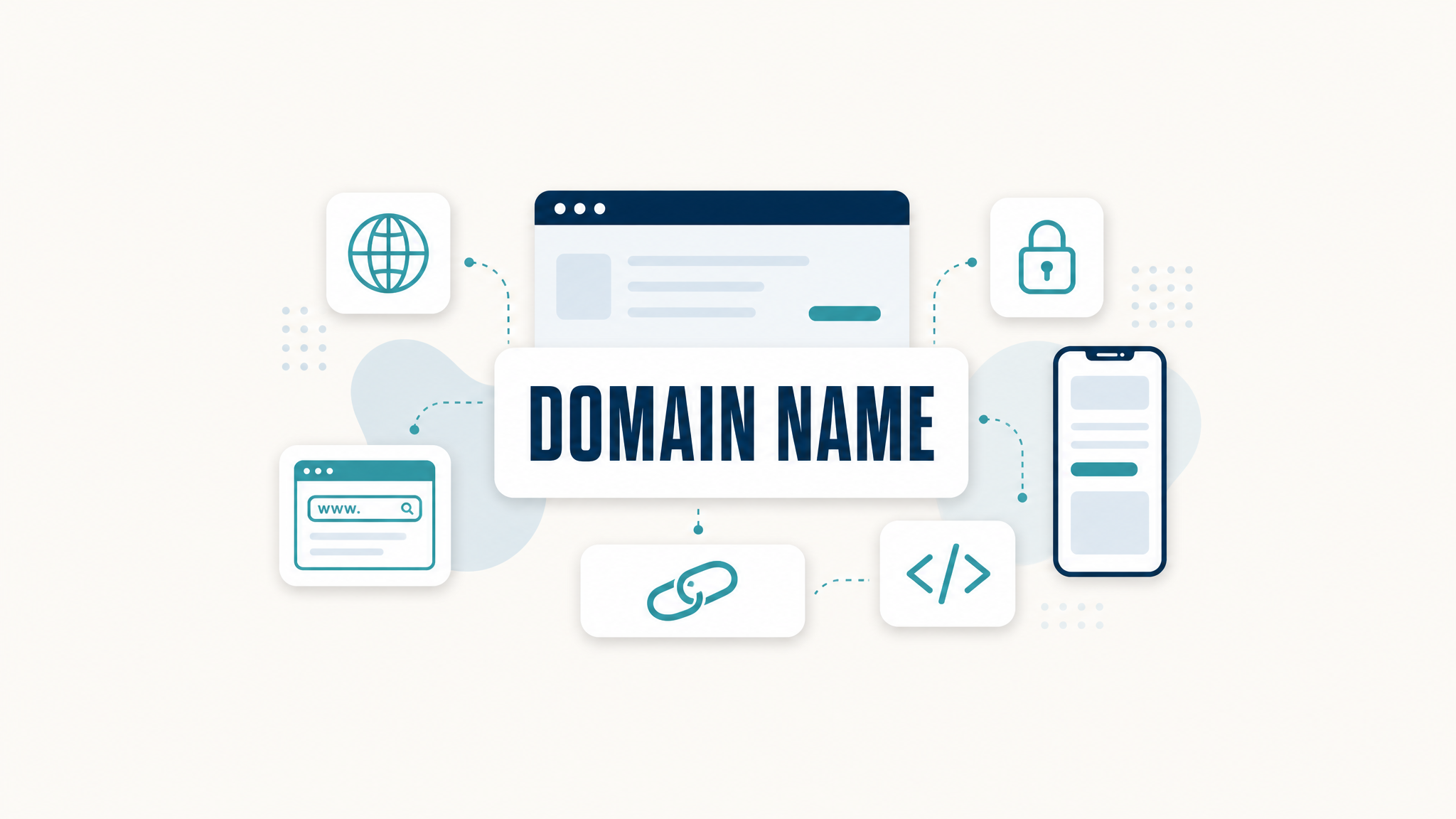
When you type a website address into your browser — say, porkbun.com or digitalyeast.com — you are using a domain name. It is the human-friendly name that tells the internet which website you want to visit.
Computers don't use names like this. They use numbers called IP addresses. A domain name is simply a memorable label that points to those numbers, so you don't have to remember long strings of digits just to open a web page.
There is a little more to it than that, and the word is often confused with another one: URL. Let's clear that up.
Domain name vs URL: what's the difference?
A URL (Uniform Resource Locator) is the full web address you see in your browser's address bar. A domain name is only part of that address.
- A URL looks like this:
https://porkbun.com/pricing - The domain name inside it is just:
porkbun.com
So a domain name is part of a URL. But there's a useful second case: a URL and a domain name can be exactly the same. When you type porkbun.com with no extra path, the domain name is also the entire URL. Both things are true — a domain can be part of a URL, or the whole thing.
How a domain name is structured
Domains are split into parts separated by dots. The last part is called the top-level domain, or TLD.
- In
porkbun.com, the TLD is.com - In
digitalyeast.co.uk, the TLD is.co.uk - In Nigeria you'll often see
.com.ngand.ng
TLDs are the simplest to understand as "the category at the end of the name" — .com is by far the most common, but there are hundreds of others.
Where you get a domain: registrars
You don't buy a domain from the internet as a whole. You register it through a company called a domain registrar — a business licensed to sell domain names. Well-known registrars include Porkbun, which is popular for its low prices and simple interface.
If you're in Nigeria and want a local .ng or .com.ng address, a good place to look is Smart Web, which registers ".ng" domains.
Registering a domain is usually cheap and is done on a yearly renewal basis — you pay to keep the name for another year so no one else can take it.
What about subdomains?
A subdomain is an extra label added to the front of your domain. It lets you run different areas of your site under one name.
blog.digitalyeast.comcould host our blogshop.yourstore.comcould host your online shopmail.yourdomain.comoften points to your email
So digitalyeast.com is the main domain, and blog. is the subdomain in front of it. You don't pay extra for most subdomains — they all belong to the one domain you registered.
Domain name vs web hosting vs email hosting
Once you have a domain, you still need somewhere for your website to actually live — and a way to send and receive email. These are three separate things, and they are often charged separately:
- The domain name is your address. It tells people where to find you.
- Web hosting is the land. It's rented space on a server where the files of your website are stored.
- The website itself — its files and code — is the house built on that land.
- Email hosting is the mailbox on the property; it uses your domain to send and receive messages like
[email protected].
Because they're separate, you often pay different bills for each. You pay a registrar for the domain, a hosting company for the server space, and sometimes another provider for email. They don't all have to come from the same company — and you can usually change one without touching the others.
We don't register domains for our clients — and here's why
A common question people ask us when we build them a website is: "Can you register the domain for me too?"
We deliberately don't — at least not on our own behalf. We don't currently sell domain registration, and we recommend you register the domain yourself through a registrar.
Why? Because if someone else owns the address, they control who lives in the house. The same is true of your online property. If your domain is registered under someone else's account, that person effectively controls your website's address. They could let the renewal lapse, transfer it, or hold it hostage.
That's why we prefer to give our clients more control over their own property. We'll gladly help you choose the right registrar and guide you through registering and renewing, but the account and the name stay in your name from day one.
By keeping ownership with you, there's no awkward moment years down the line if we're no longer working together — you keep your address, your email, and your brand, no matter what.
If you'd like a hand choosing a registrar, setting up your domain with email hosting, or building the website that will live on it, we're here to help. Tell us about your project and we'll point you in the right direction.

Comments (0)
No comments yet. Be the first to share your thoughts!
Leave a Comment
Your email address will not be published. Required fields are marked *