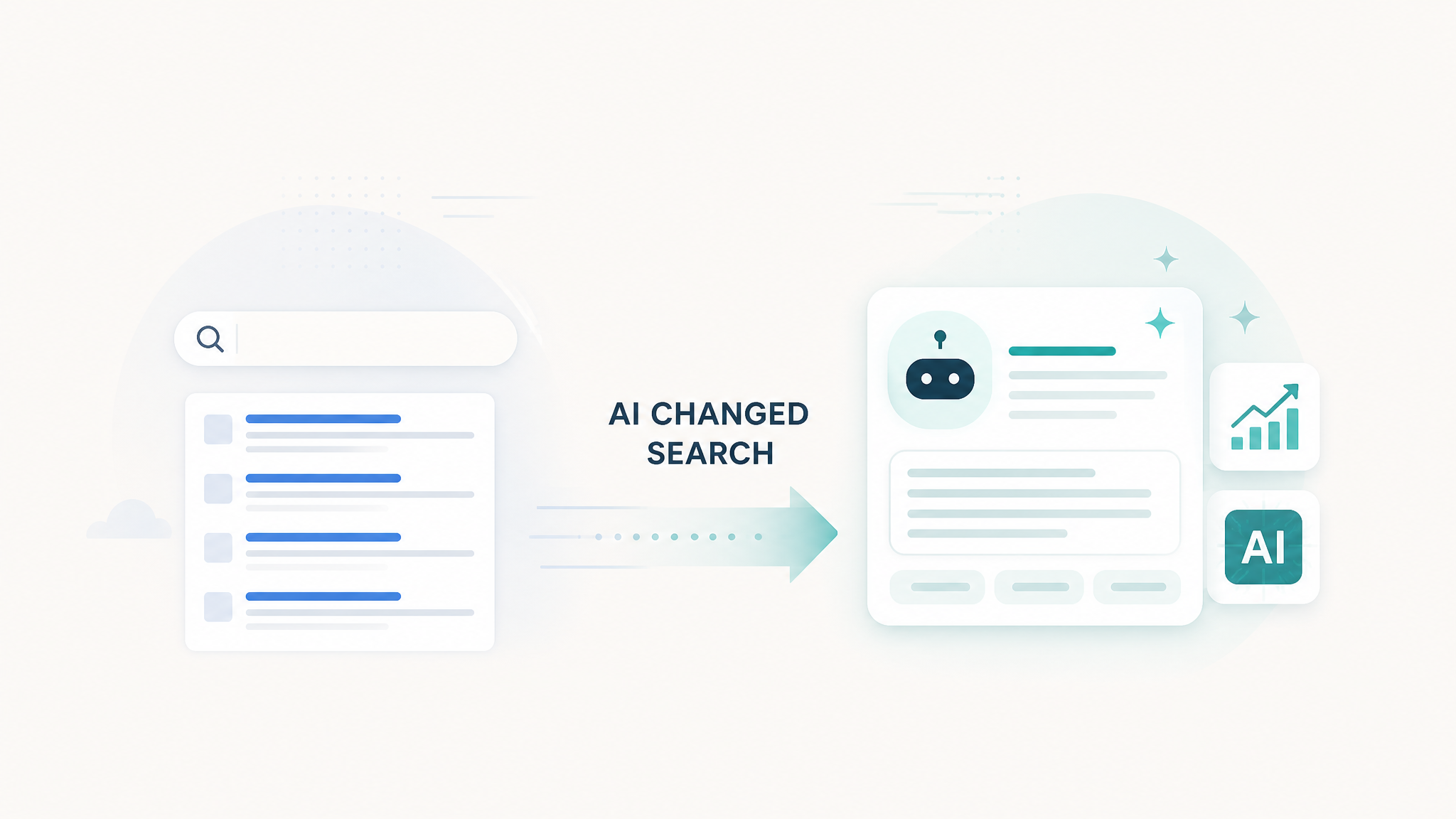
For twenty years, the rules of SEO were brutally simple: get to position one on Google, get the clicks. It was a winner-takes-all game played on a single stage, and the whole industry built itself around that one metric. Then, in the span of about eighteen months, the stage itself changed.
Search used to be a list of blue links. Today, before a single organic result appears, Google can hand out an AI-written answer, a map, a video carousel, a shopping block and a stack of featured snippets — and increasingly, it can answer your question without sending you to any website at all. Add ChatGPT, Perplexity and Gemini answering people who never open Google, and the old playbook looks almost obsolete.
But here's the part most "AI killed SEO" posts get wrong. Search didn't vanish. It fractured. And the numbers prove that those who adapted are still winning — they're just winning differently.
This is Part 2 of our SEO course. If you're new, we recommend starting with Part 1: What is SEO and how search engines work. Below, we've cut through the hype and collected the real statistics — the studied, sourced numbers — so you can see exactly how AI has changed SEO, and what it means for your business.
How AI Overviews Actually Took Over the SERP
Let's start with the headline change: Google's AI Overviews. These are the AI-generated summaries that appear at the top of many search results, answering the query directly and making the classic "ten blue links" less necessary.
How common are they? It depends who you ask, because every measurement firm looks differently:
- Ahrefs found that roughly 21% of keywords triggered an AI Overview across 146 million SERPs analysed, and that the figure swings dramatically by intent — question queries trigger them 57.9% of the time, while single-word queries trigger them under 10% of the time.
- Semrush tracked AI Overview share as volatile through 2025: from about 6.5% of queries in January up to a peak near 24.6% in July, before pulling back to roughly 15.7% by November.
The wide range is the first honest lesson: AI Overview penetration is not one number. It varies by methodology, by market and by intent. What's consistent is the direction — and the intent split. 99.9% of AI Overviews sit on informational queries. Navigational and commercial searches still mostly show links, which matters enormously for what you should try to rank.
The Zero-Click Problem: The Number That Scares Everyone
The scariest stat, and the one that fuels the "SEO is dead" crowd, is about zero-click searches — queries where the user gets their answer on the results page and never opens a website.
SparkToro (Rand Fishkin, using Similarweb clickstream data) found that in the first four months of 2026, 68.01% of US Google searches ended without a click — up from 60.45% in 2024. In plain terms, only about 27 of every 100 Google searches now reach the open web. Search Engine Land put the click-sending share's decline at roughly 9.5 percentage points between 2024 and 2026.
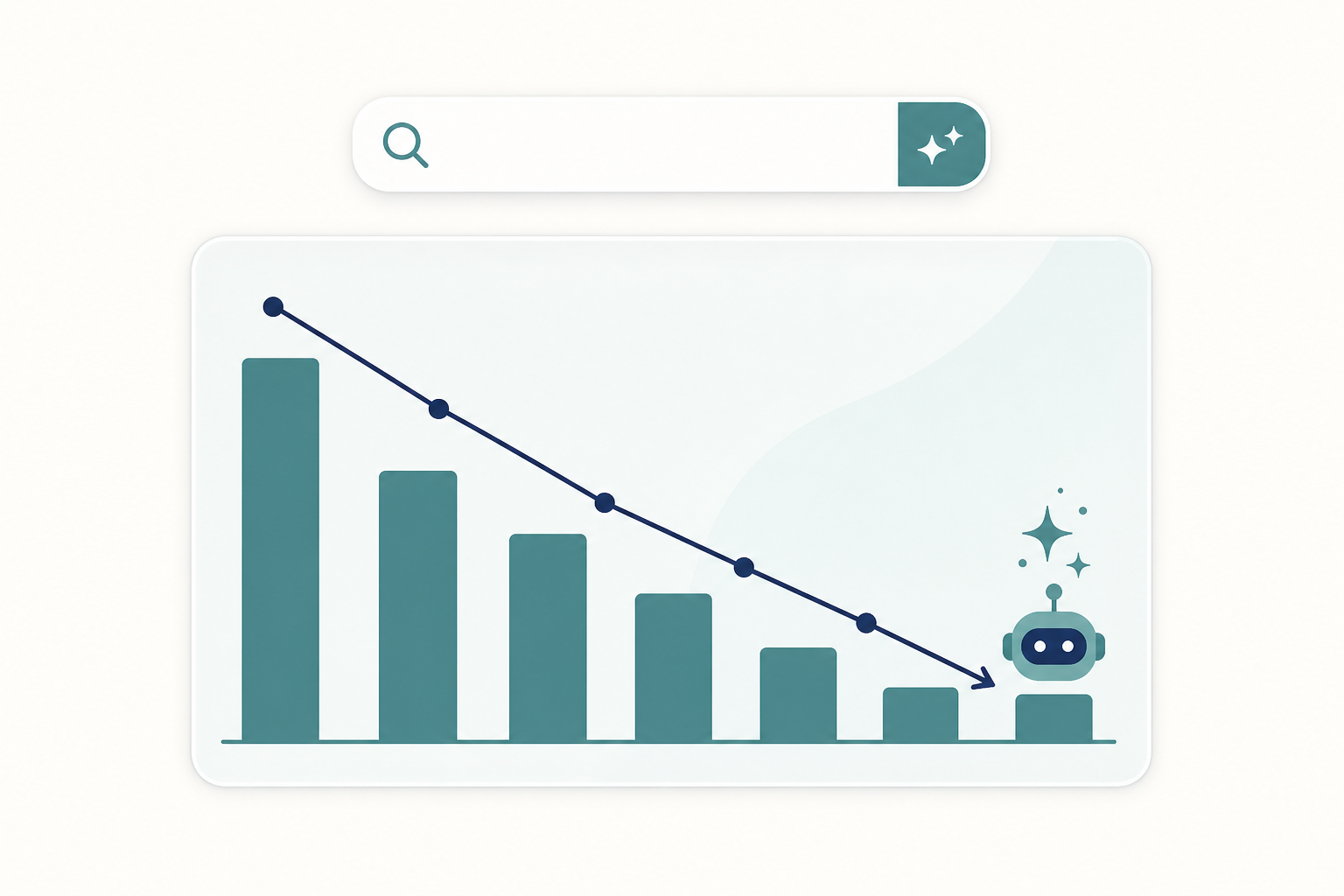
But here's the nuance most people skip: Semrush found that for the same keywords tracked before and after an AI Overview appeared, the zero-click rate actually decreased slightly (33.75% → 31.53%). In other words, AI Overviews don't automatically create zero-click searches — the broader zero-click trend is driven by richer, self-contained SERPs and changing behaviour, not by AI summaries alone.
The takeaway isn't "clicks are dead." It's that the average click is harder to earn and shares the page with more competition than ever.
Click-Through Rates: Position One Isn't What It Was
The most direct measure of AI's damage is click-through rate (CTR) — the percentage of people who actually click a result when they see it.
Here are the numbers, from multiple independent firms:
- Ahrefs found position-one organic CTR is 58% lower when an AI Overview is present (down from an earlier finding of a 34.5% reduction in 2025).
- SISTRIX measured German results and saw top organic CTR cut by 59%.
- Seer Interactive — whose data we cited in Part 1 — reported organic CTR for AI Overview queries falling 61% between June 2024 and September 2025, and paid CTR falling 68% on those same queries. Even queries without AI Overviews saw paid CTR drop 32%.
- Pew Research found US users clicked 8% of the time when an AI summary appeared, versus 15% without one.
That's five different firms, three different methodologies, all landing in the same rough band: an AI Overview roughly halves the clicks a top result would otherwise get.
There's also a silver lining worth noting. Seer's 2026 update shows the decline may be levelling off — organic CTR on AI Overview SERPs actually rose from 1.3% in December 2025 to 2.4% in February 2026, suggesting the worst of the collapse is over and we've settled into a "new normal" rather than a freefall.
It's Not Just Google: People Are Asking ChatGPT Instead
The most overlooked shift isn't inside Google at all. It's that a growing share of searches never reach a search engine in the first place.
Pew Research found that roughly half of US adults now use an AI chatbot, up from about a third in 2024, with about a quarter using them daily. Crucially, 42% say they use chatbots to search for information, and 60% say they read AI summaries at the top of search results.
Usage is led by ChatGPT at 44%, ahead of Gemini at 24% and Copilot at 17%. StatCounter's AI-chatbot data paints a similar picture, with ChatGPT holding about 78% of AI chatbot market share against Gemini's 10% and Perplexity's 6%.
Gartner predicted back in early 2024 that traditional search engine volume would drop 25% by 2026 as AI chatbots and virtual agents take share. That prediction looked radical then; two years on, it's looking more like a forecast than a scare story.
The keyword shift is equally telling. Semrush found navigational search triggers for AI Overviews rocketed from 0.74% of queries to 10.33% across 2025, with commercial triggers climbing from 8.15% to 18.57%. When people start asking AI assistants for brand-specific and buying-intent searches, the game changes for businesses that used to rely on ranking for their own name.
What This Actually Means for Your Business
So — does AI kill SEO? No. The numbers kill the old SEO — the shallow, "write a thin article and wait for position one" kind. But they reward the opposite.
Here's what the data says works in 2026:
- You can't rely on informational content alone. With 99.9% of AI Overviews targeting informational queries and CTR roughly halved there, betting everything on "how to" blog posts is a losing play. Use them to earn AI citations and brand awareness, not as your main revenue channel.
- Being cited is worth real money. Seer found that being cited in an AI Overview yields +35% organic clicks and +91% paid clicks versus not being cited. Get your entity into the answers, not just the ranks.
- The same five domains win the citations. Ahrefs found AI Overviews cite YouTube 21.1% of the time, Reddit 18.5% and Facebook 10.7%. It's not enough to have a website — you need to be present where AI trusts content, which includes communities, reviews and your own brand's authority.
- Business and local intent still converts. Navigational, commercial and transactional searches still send clicks, and your website, portfolio, prices and contact details can't be replaced by an AI summary. This is exactly the point we made in our guide to the benefits of a business website — AI answers questions, but it doesn't replace your storefront.
In short: SEO isn't dead. Gaming it is. The sites that win now are the ones that combine real, structured, trustworthy content with genuine business signals — which is exactly what we cover in Part 3 of this course: On-Page and Technical SEO Fundamentals.
Want to make sure your site survives AI search? We build fast, well-structured websites and handle the technical and on-page fundamentals for our clients. Get a quote from Digital Yeast.
This is Part 2 of the Digital Yeast SEO course. Part 1 covers the foundations. Read Part 3: On-Page and Technical SEO Fundamentals next to learn how to actually rank in this new landscape — or browse all of our blog posts.
Sources
- Ahrefs — What Triggers AI Overviews? and AI Overviews Reduce Clicks by 58%
- Semrush — AI Overviews Study
- SparkToro — In 2026, less than one-third of Google searches still send a click
- Search Engine Land — Google zero-click searches reach 68%
- Search Engine Journal — Google AI Overviews cut Germany's top organic CTR by 59%
- Seer Interactive — AIO Impact on Google CTR: Sept 2025 and 2026 Update
- Pew Research — Americans and AI 2026 and Google users are less likely to click when an AI summary appears
- Gartner — Search Engine Volume Will Drop 25% by 2026
- StatCounter — Search Engine Market Share and AI Chatbot Market Share
- Ahrefs — The 50 Most-Cited Websites in Google AI Overviews
Comments (0)
No comments yet. Be the first to share your thoughts!
Leave a Comment
Your email address will not be published. Required fields are marked *