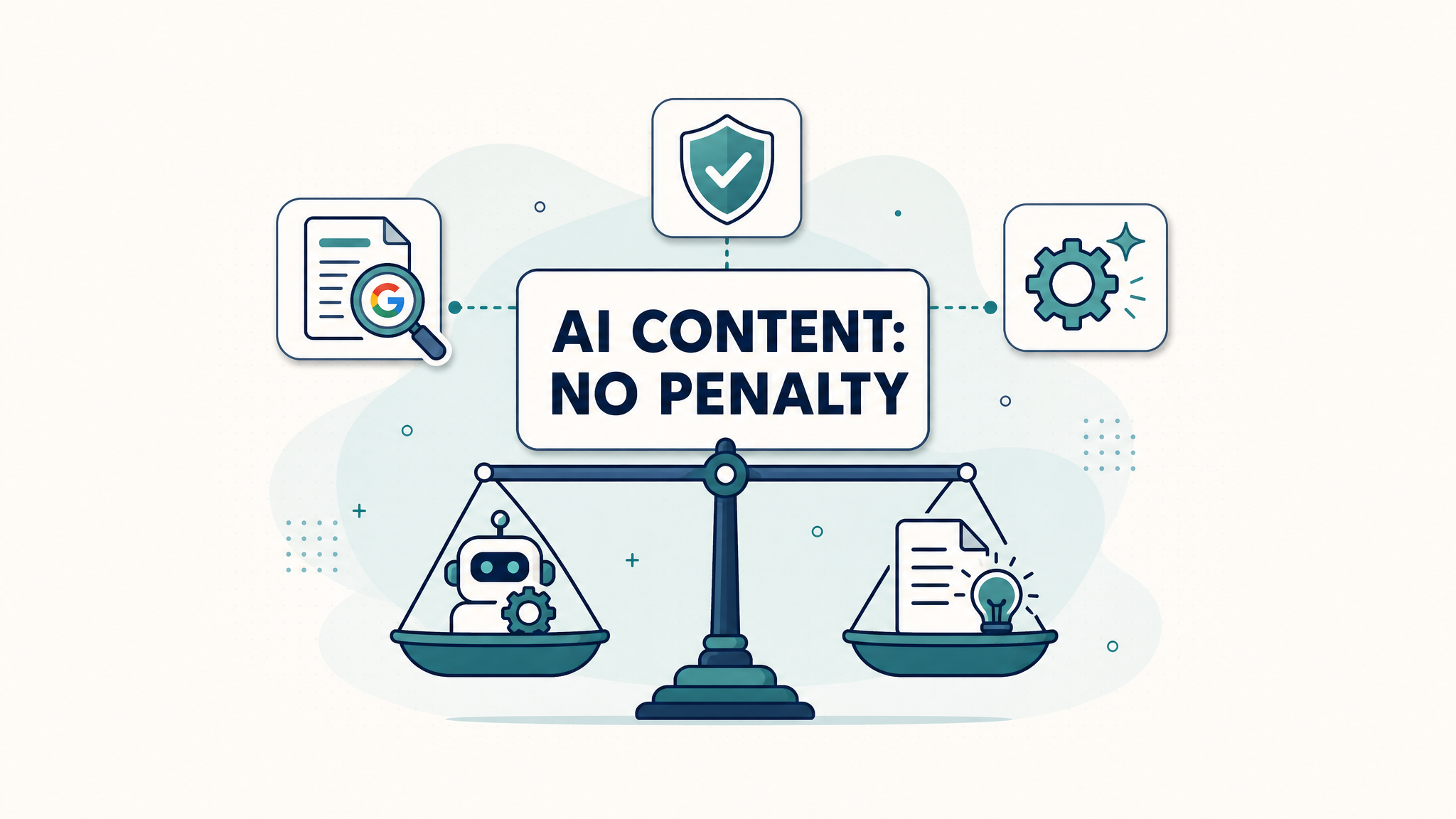
Ask ten SEOs "does Google penalize AI content?" and you'll get ten anxious answers, most of them wrong. The short, defensible, official answer is no — Google does not penalize AI content simply because it's AI. What it penalizes is spammy, scaled, low-value content, regardless of whether a human, a machine, or the two together produced it.
That distinction matters more than ever. After the March 2024 core and spam updates, Google said its changes would "reduce low-quality, unoriginal content in search results" — and by the time the rollout completed in April 2024, Google confirmed those updates had removed 45% of low-quality, unoriginal content from search results. Plenty of sites that published masses of AI-generated pages saw rankings collapse. But not because of the AI. Because the content was scaled and valueless.
This is one of the most misunderstood questions in SEO today. In this guide I'll give you the exact, citable position from Google and Bing, what the "scaled content abuse" policy actually targets, how AI content differs from unhelpful content, and practical E-E-A-T steps so you can use AI safely.
The exact Google quote: AI content is not against the guidelines
Let's start with Google's own words, from its official Search Central guidance on AI-generated content (February 2023). Under the FAQ "Is AI content against Google Search's guidelines?", Google states:
"Appropriate use of AI or automation is not against our guidelines. This means that it is not used to generate content primarily to manipulate search rankings, which is against our spam policies."
Read that twice, because it's the whole argument in one sentence. The word that does the heavy lifting is "appropriate." Google's position has never been "AI is bad." Its position is that AI is fine as a tool — and it becomes a problem only when it's used to generate content primarily to manipulate rankings. That's spam, and spam is penalized however it's produced.
The same post makes the deeper point explicit:
"Our focus on the quality of content, rather than how content is produced, is a useful guide that has helped us deliver reliable, high-quality results to users for years."
So the official line is: quality is the target, not the tool. Google's own framing notes automation has long produced helpful content such as "sports scores, weather forecasts, and transcripts." Nobody would penalize a weather site for being automated. The penalty logic only kicks in when automation is used to game results.
AI content vs. unhelpful content: the crucial distinction
Here's the mistake that ruins sites: treating "AI content" and "bad content" as synonyms. They're not. Google doesn't have an "AI content" policy — it has spam policies and a helpful content system, and both operate on quality, not method.
The key concept is what Google calls "scaled content abuse." This is the policy that replaced the old "spammy auto-generated content" rule in the March 2024 spam update, and it's the one most people are actually worried about when they ask about an "AI content penalty." Here's the current definition from Google's spam policies:
"Scaled content abuse is when many pages are generated for the primary purpose of manipulating search rankings and not helping users."
Notice what's not in there: the word "AI." Google's own guidance on generative AI content makes this unmissable — I'll quote the relevant line directly:
"Using generative AI tools or other similar tools to generate many pages without adding value for users may violate Google's spam policy on scaled content abuse."
Two qualifiers, and both are about scale and value, never about AI itself:
- "many pages" — the problem is volume produced to farm rankings, not a single AI-assisted article.
- "without adding value" — the problem is content that doesn't help users, not content that an AI wrote.
When Google strengthened this policy in March 2024, it explicitly widened it beyond automation. From the official announcement:
"We're strengthening our policy to focus on this abusive behavior — producing content at scale to boost search ranking — whether automation, humans or a combination are involved."
That "whether automation, humans or a combination are involved" line is the most important sentence in the modern spam policy. Google isn't hunting for AI — it's hunting for scaled manipulation, whoever or whatever does it. A human who writes 1,000 thin, templated pages is just as exposed as an AI doing the same.
What John Mueller actually says about AI content
Google's Search Advocate John Mueller has been even more direct than the formal policy. In response to a Reddit question about whether a site could recover from low-quality AI content by rewriting pages with human authors, Mueller reframed the entire premise:
"I wouldn't think about it as AI or not, but about the value that the site adds to the web. Just rewriting AI content by a human won't change that, it won't make it authentic."
That's the exact same message as the policy, in plain English: it's about value, not authorship. And it's a useful mental model. If you're worried about your AI content, stop asking "is Google punishing me for using AI?" and start asking "does this site genuinely improve the web?" As Search Engine Journal covered, Mueller advises sites in a "bad state" to rethink their purpose rather than treat recovery as a page-by-page rewrite job.
Where Bing stands: the same quality logic, applied differently
If Google doesn't penalize AI content, what about Bing? The short answer is that Bing shares the same quality-first view, but has been more openly enthusiastic about AI — unsurprising, since Microsoft is behind both Bing and OpenAI (maker of ChatGPT).
Bing's official Webmaster Guidelines don't ban AI content. Instead they tie SEO best practices to AI visibility:
"SEO best practices that support discovery, indexing accuracy, and content clarity also support eligibility for AI-generated experiences, grounding results, and ..." (Bing Webmaster Guidelines)
The takeaway matches Google's: Bing rewards clear, well-structured, discoverable, genuinely useful content — not any particular production method.
Where Bing differs is in how it's leaning into AI. Two changes signal the direction:
- Generative Engine Optimization (GEO) in the guidelines. In early 2026, Microsoft added GEO coverage to its official Bing Webmaster Guidelines — formal acknowledgment that being cited inside AI-generated answers is now part of search marketing.
- AI Performance reporting in Bing Webmaster Tools. In February 2026, Bing launched an AI Performance report that shows where and how often your content is cited across Microsoft Copilot and Bing's AI summaries. It was the first major search engine to give publishers this kind of AI-citation visibility.
So Bing isn't fighting AI content — it's measuring and monetizing the AI content economy, which only works if your content is worth citing. That brings us back to quality. For AI-visibility specifically, see our Generative Engine Optimization guide.
What actually gets penalized: the real-world pattern
Now let's connect the policy to what actually happened. The chaos of 2024 wasn't an "AI crackdown" — it was a quality cleanup that disproportionately swept up sites that had used AI to mass-produce thin pages. The pattern that got sites hit looked like this:
- Hundreds or thousands of pages published quickly, targeting every conceivable long-tail keyword.
- Little to no original information, experience, or data — just reworded versions of what already ranked.
- No real authorship — no named expert, no credentials, nothing that signals E-E-A-T.
- Pure intent to rank, often with pages that "pretend to have answers to popular searches but fail to deliver helpful content" (Google's own phrase for scaled content abuse).
Google pinned a number on the goal: those updates were expected to cut low-quality, unoriginal content by 40%, and delivered 45%. If your site won by being genuinely useful, they generally helped you. If it won by being everywhere and saying nothing, they didn't.
The definitive signal of the intent-based nature of all this: Google said the policy applies "whether automation, humans or a combination are involved." If Google cared about AI as the problem, it would name AI as the trigger. It names scale and manipulation instead.
Practical E-E-A-T takeaways: how to use AI without getting hit
So, can you use AI? Yes — responsibly. Here's the practical checklist, built around Google's E-E-A-T framework (Experience, Expertise, Authoritativeness, Trustworthiness), which is the actual ranking lens regardless of how content is produced:
Add real human expertise on top of the AI draft. AI generates structure and first drafts brilliantly. It does not have the experience or judgment to write authoritatively about your business. Have a human expert review, correct, and deepen every piece with firsthand detail and specifics AI couldn't know.
Publish under a named author with credentials. Google has said it's "probably not the best way" to list AI as an author, and it recommends clear bylines "when readers would reasonably expect it." A real named expert, with a bio, signals E-E-A-T that "Editorial Staff" or "AI" can't.
Only create content you can genuinely add value to. If you're chasing keywords you have no real knowledge of or data on, stop — that's the scaled-content-abuse trap. Write where you have experience.
Disclose AI usage where it's reasonably expected. Google specifically says AI disclosures are "useful for content where someone might think 'How was this created?'" It's a trust signal, not an admission of guilt.
Keep every page people-first, not rankings-first. Before publishing, ask Google's own "Who, How, Why" questions. If the answer to "who is this for?" is "the search engine," you're on the wrong side of the line.
Prefer depth over volume. One authoritative, well-argued article outranks — and survives — ten thin ones. This is the single biggest difference between the sites that got hammered in 2024 and the ones that grew.
If you want the mechanical foundation underneath all of this — structure, crawlability, and content that browsers and machines alike can parse — our On-Page and Technical SEO fundamentals guide covers it in depth.
The bottom line
Let's answer the title question directly.
Does Google penalize AI content? No. Google penalizes scaled content abuse — the mass production of low-value pages for the purpose of manipulating rankings. That penalty applies "whether automation, humans or a combination are involved." AI is not the target; manipulation is.
Does Bing penalize AI content? No. Bing takes a similar quality-first view and has leaned into AI, adding GEO to its guidelines and measuring AI citations in Webmaster Tools.
The safest strategy in 2026 is the same as it was in 2016 and 2006: create genuinely useful content, demonstrate real expertise, and treat AI as a powerful assistant rather than a shortcut to scale. Do that, and the AI question stops being scary entirely.
Want the full picture? This pairs with our SEO course — start with Part 1: What is SEO, Part 2: How AI changed SEO, or Part 5: Content SEO to build the foundations — or browse the whole course.


Comments (0)
No comments yet. Be the first to share your thoughts!
Leave a Comment
Your email address will not be published. Required fields are marked *